


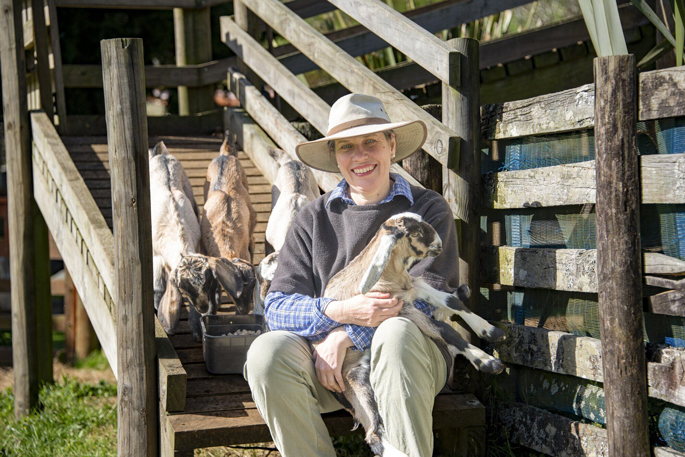
In secluded bush on the hills above the Karangahake Gorge at the southern end of the Coromandel, Sue Austen is continuing her parents’ legacy on a property owned by the family for the past 40 years.
“My parents, Jan and Keith Austen, bought Bullswool Farm in the mid-80s and knew the 30ha block was never going to be a viable farm, but what they developed was definitely a lifestyle block on steroids,” Sue says.
Jan and Keith bought two goldfish for a pond on a rural West Auckland property and when they unexpectedly spawned, the couple suddenly found themselves with 1000-odd baby goldfish.
Jan thought there could be money in this, Sue says, so she developed a large goldfish farm,
“Which did make some good money for a number of years.”
When they retired early to Bullswool Farm, Jan became immersed in breeding rare farm animals, such as alpacas, llamas, donkeys and miniature horses. She also bred dogs on a large scale but cut back when the farm park opened.

Jan and Keith Austen created Bullswool Farm.
Sue’s father Keith wrote a book called Bullswool and Barbed Wire, which became a self-published runaway success. It contained humorous and mainly true rural yarns, set to verse and illustrated by Malcolm Evans.
What they were doing at Bullswool with the rare breeds and the popularity of Keith’s book earned the family an episode on TVNZ’s Country Calendar in the 1990s.
Running a farm park
“During this time, I was living overseas, and I kept hearing all these stories about people who wanted to visit the farm and meet dad, who was becoming a bit of a local celebrity, and see the exotic animals mum was breeding.”
Sue returned to New Zealand in 2003. Farm parks are big in Britain and the family decided to open their farm by booking only and with paid entry. Bullswool Farm Park opened in 2004.
“Quite a lot of work was involved in the initial set-up. We made a fenced route around the farm, which includes a bush reserve walk, a viewpoint up the hill, a play paddock, and several sheds were converted into rural life museums.”

Children love getting up close with the animals.
The park offered children who may not have had much to do with animals the chance to walk from paddock to paddock and have face-to-face interaction with them, and it still fulfils that purpose today.
“Our museums are an ongoing work in progress, and we enjoy curating displays around how farming life used to be. We have a good collection of old implements, tools and machinery from the past.”
Rare breeds
Sue continues with boutique breeding of rare and high-value animals.
“Animal fads come and go, and my rule of thumb is that if there is no demand for a neutered male of a breed, then it is no longer viable to breed that type of animal.”
Every animal on Bullswool farm serves a purpose. Breeding is carefully considered and Sue says donkeys are currently a big thing, especially miniature donkeys and Irish donkeys.
“With larger companion animals like donkeys, we want them to leave us as well-handled and trained as possible. This helps ensure they are a pleasure to own, and consequently are always easy to rehome, as is often necessary with such long-lived animals.”
The goats enjoy walks through the bush reserve on the farm and closely follow Sue like dogs.
Apart from the donkeys, Bullswool has Baby Doll sheep, which Sue says breed easily with other sheep. They also have great fleeces and good meat for eating. At the moment, Sue is concentrating on breeding Baby Dolls with the typical traits of the breed.

Miniature and Irish donkeys are popular lifestyle block animals.
Several coops house chickens, ducks and exotic-looking golden pheasants.
The animals are in paddocks, which are usually breed-specific, with cattle, sheep, Nubian goats, miniature horses, donkeys, kunekune pigs and alpacas. They are fed a pasture-based diet as close as possible to what they would eat as undomesticated animals.
Sue says the farm has plenty of grass available and the pelletised lucerne the animals get hand-fed by visitors is the cherry on top.
Future plans
Sue is always looking for ways to diversify and maximise income sources, as her entrepreneurial parents did. She runs an Airbnb and has the Goats in the Garden coffee and ice cream cart.
“Our next ventures include an adult’s bike track, promoting our feijoa ice cream and expanding our gift shop to have more core New Zealand brands and products.”

0 comments
Leave a Comment
You must be logged in to make a comment.