


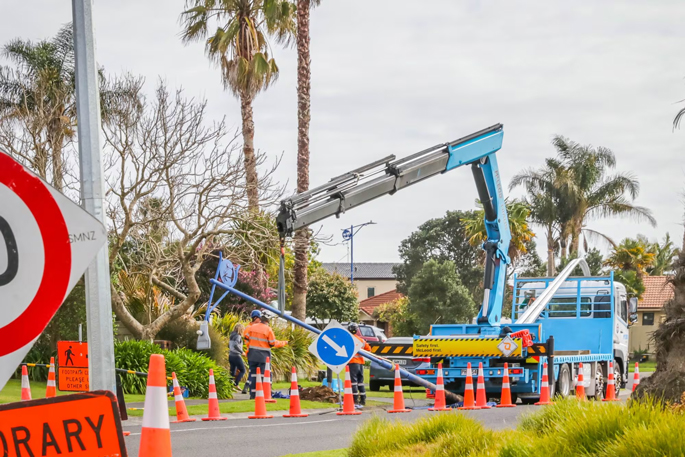
A Pāpāmoa resident says the suburb’s distinctive lamp-posts are part of its character.
Decorative streetlight poles were installed by subdivision developers in the late 1990s and early 2000s.
Pāpāmoa Residents and Ratepayers Association chairman Philip Brown said individual subdivisions were originally given distinctive lamp-post designs, which helped differentiate neighbourhoods.
“These are part of our character and heritage.”
Tauranga City Council has been replacing them over the years with standard galvanised poles, which Brown said was gradually making neighbourhoods look the same.
He believed the remaining distinctive posts would eventually disappear.
“Sovereign Drive, Gloucester Rd have been just absolutely smashed and replaced with galvanised ones all the way through.”
He said within five to 10 years, the council would replace all of them and “our heritage will be lost”.
He said the lamp-posts were a “nice to have”, rather than a necessity, but argued small neighbourhood features deserved preservation.
“Otherwise, we just become a bland sameness everywhere.”
He said the council told him the replacement programme was because of concerns about corrosion, particularly underground.
He suggested replacing the bottom piece and keeping the distinctive design.
Brown said the situation was similar to a previous issue the community had with the council replacing asphalt streets with chipseal.

Pāpāmoa Residents and Ratepayers Association chairman Philip Brown.
Pāpāmoa residents have complained that chipseal made roads noisier, rougher and less durable.
The council claimed chipseal was five times cheaper than asphalt.
In a meeting in November 2025, Mayor Mahé Drysdale said like-for-like suburban asphalt resurfacing would “likely mean an increase of at least 2% in rates for every household, which we didn’t feel was an equitable outcome”.
The council decided to let ratepayers self-fund the price difference to have their streets resealed with asphalt, if the whole street agreed.
Asked if Brown believed Pāpāmoa residents should have to self-fund the lamp-posts, he said the difference in cost was not large enough to bother asking residents and “they [the council] should just do it”.
Tauranga City Council transport system operations manager Shawn Geard said the council appreciated decorative streetlighting contributed to the character of some neighbourhoods.
“However, the council must balance aesthetic considerations with safety, reliability, whole-of-life asset management, and prudent use of ratepayer funding.”

Examples of decorated lamp-post designs in Pāpāmoa. Photo / Kelly O'Hara
He said the priority remained ensuring all residents had access to safe and dependable street lighting across Tauranga.
Geard said private developers installed the decorative streetlight poles as part of subdivision developments and selected them to complement the character and appearance of individual neighbourhoods.
He said the council replaced streetlight poles as part of its ongoing asset management programme when they reached the end of their serviceable life, showed significant corrosion, or no longer met required safety standards.
Streetlight poles were assessed individually and replaced based on their condition, age, safety and remaining service life.
“While [the] council recognises that decorative poles contribute to neighbourhood character, replacing ageing poles on a like-for-like basis is generally not financially practical.”
He said decorative poles were significantly more expensive to procure, maintain and replace than standard streetlighting poles.
Geard said, in most cases, it was not feasible or advised to replace sections of a streetlight.
“Modifying or replacing individual sections can introduce structural uncertainties, create additional points of weakness, and increase the risk of future corrosion.”
This could also complicate future maintenance.
Geard said the cost difference varied depending on the specific pole design, availability and installation complexity.

A beach-themed design on Sorrento Key, Pāpāmoa. Photo / Kelly O'Hara
“Decorative poles are typically significantly more expensive than standard galvanised streetlight poles.”
He said in many cases, decorative poles required custom manufacture or specialised components.
In an email forwarded to Pāpāmoa Residents and Ratepayers Association, Geard said a typical pole replacement cost $3000 to $5000.
The cost of a decorative pole could vary from $4500 to $7500.
Painting a replacement pole added $800 per pole and some colours and locations required mid-life repainting.
He said 39% of the light poles were beyond their 25-year design life and Pāpāmoa’s coastal conditions and poor-draining soil accelerated below-ground corrosion.
He knew of one complaint to the council in the past six months about decorative poles being replaced, but said other residents had told teams on site the new poles looked better than the old, faded, dated ones.
“The approach of not renewing decorative streetlights like-for-like has been in place since a council decision of September 2011.”
He said the decision was part of a broader cost-saving approach to reduce impacts on ratepayers.
He noted the city centre and Mount Maunganui’s main street had decorative streetlights.
Ayla Yeoman is a Local Democracy Reporting journalist based in Tauranga. She holds a Bachelor of Arts majoring in communications, politics and international relations from the University of Auckland, and has been a journalist since 2023.
LDR is local body journalism co-funded by RNZ and NZ On Air.


0 comments
Leave a Comment
You must be logged in to make a comment.