


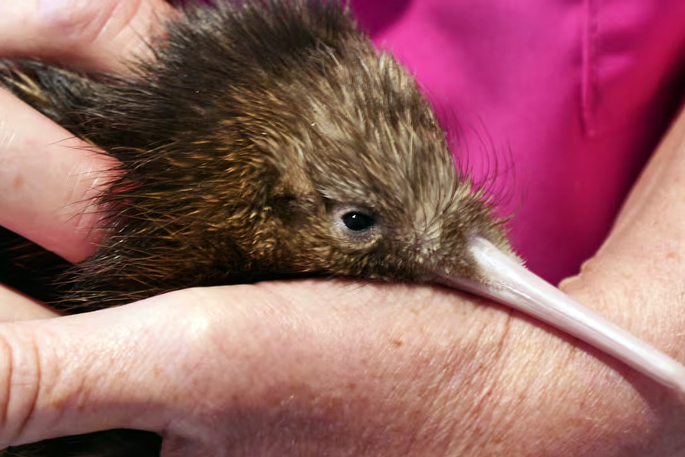
Caesar may have an impressive name, but the kiwi’s origins are less regal.
The chick takes his name from the Caesar cut, a short, forward-combed hairstyle named after Roman ruler Julius Caesar and popular in the 1990s.
The chick hatched on September 11 at the Gallagher Kiwi Burrow in Taupō where the first eggs of the 2026 breeding season arrived from Cape Sanctuary and Maungataniwha in Hawke’s Bay.
Kiwi chicks at Cape Sanctuary are named after hairstyles.
The inspiration came from Prize, a male kiwi at Cape Sanctuary who often got carried away while preening his chicks, leaving some with distinctive “haircuts”.
Prize is Caesar’s father, but the chick has escaped the over-zealous grooming but still got the name.
Cape Sanctuary is New Zealand’s largest predator-fenced, privately owned and funded wildlife sanctuary. Andy and Liz Lowe and Julian Robertson founded it in 2006 and it operates in partnership with Ngāti Mihiroa.
National charity Save the Kiwi operates Kiwi Burrow.
The Waikato Herald was given a behind-the-scenes look at the Gallagher Kiwi Burrow at Wairakei Golf & Sanctuary as the facility began its seventh breeding season.
For the facility’s keepers, the journey from egg to kiwi starts well before the first crack appears in the shell.
They check and measure eggs before putting them in an incubator that automatically rotates them. This mimmicks the movement of an incubating male kiwi.
Keepers also candle the eggs, which involves shining a light through the shell to see the developing chick inside.
 Gallagher Kiwi Burrow team members Helen McCormick (left) and Kim McGuire with a kiwi plushie at Wairakei Golf & Sanctuary in Taupō. Photo / Tom Eley
The eggs are one of the most fascinating parts of the job for Save the Kiwi’s senior kiwi keeper Kim McGuire and husbandry manager Helen McCormick.
“Most people probably think the birds and chicks are our favourite part, but I think for both Helen and I, it’s the eggs,” McGuire said.
“You have this thing that is just, add a bit of heat and they totally develop into those chicks.
“Just phenomenal.”
As hatching approaches, the keepers watch closely for the chick’s position.
 A kiwi egg at the Gallagher Kiwi Burrow in Taupō. Photo / Tom Eley
At one end of the egg is an air cell, a pocket of air separated from the rest of the egg by a membrane.
The chick needs to get its bill towards the air cell so it can begin breathing.
If it is facing the wrong way, it can struggle to hatch and keepers may need to intervene.
The best hatches were the ones where keepers did not have to intervene, McGuire said.
Once the chicks are out, staff weigh and check them daily. The yolk absorbed before hatching provides nourishment while they learn to feed themselves.
Keepers did not immediately know whether a chick was male or female, McCormick said.
Feathers are collected while the birds are at the Burrow and sent away for sex testing.
 Kiwi feathers at the Gallagher Kiwi Burrow in Taupō. Photo / Tom Eley
After about three to four weeks, the chicks leave the Burrow for a kiwi crèche or predator-controlled sanctuary.
There they continue growing towards about 1kg, known as the “stoat-proof weight”, when they have a much better chance of surviving introduced predators.
Wairakei Golf & Sanctuary general manager operations Warren Collett said about six or seven kiwi were currently roaming the property, although a couple had lost their transmitters.
“They’re roaming around out there having a ball,” Collett said.
A part-time ranger checks the sanctuary’s external predator fence, while about 250 traps are maintained across the property.
The Gallagher Kiwi Burrow has hatched more than 450 kiwi since opening in October 2019, with eggs arriving from conservation projects throughout the North Island.
 Caesar is carefully checked by staff at the Gallagher Kiwi Burrow in Taupō. Photo / Tom Eley
Keepers avoid treating them like pets, despite spending weeks caring for them.
“These are wild animals and we don’t cuddle them,” McGuire said.
Some chicks quietly tolerate their daily checks. Others are more vocal.
“Some can be very, very vocal,” McGuire said.
“They really tell us what they think of us.”
Caesar still has plenty of growing to do. At his latest weigh-in, he tipped the scales at just 300g.
For now, the young kiwi remains under the watchful eyes of his keepers, who weigh him, check his progress and make sure he is growing as he should.
If all goes to plan, he will leave Taupō and take his place in the forest.
Tom Eley is a multimedia journalist at the Waikato Herald. Before he joined the Hamilton-based team, he worked for the Weekend Sun and Sunlive. He previously worked as a journalist at Black Press Media in Canada and won a fellowship with the Vancouver Sun.

0 comments
Leave a Comment
You must be logged in to make a comment.