


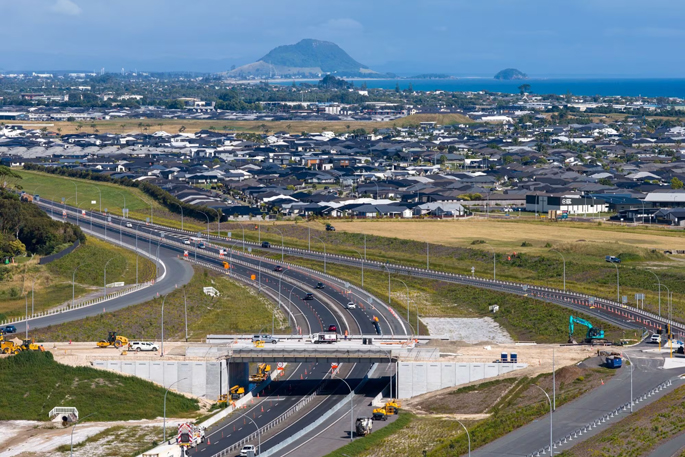
A Government-led “regional deal” could help unlock key issues facing the Bay of Plenty’s billion-dollar kiwifruit industry.
Infrastructure Minister Chris Bishop said the Western Bay of Plenty deal brought together Tauranga City Council, Western Bay of Plenty District Council and Bay of Plenty Regional Council with the Government in a shared commitment to plan, invest and deliver for the region and New Zealand’s long-term benefit.
Jason Te Brake, chief executive of Mount Maunganui-based kiwifruit marketer Zespri, said the industry supported the co-ordinated, long-term approach to infrastructure development.
“The Western Bay of Plenty is critical to Zespri and the kiwifruit industry, with around 80% of our New Zealand fruit grown in the region and more than 95% exported through the Port of Tauranga.
“We are already seeing infrastructure constraints and, without action, they will worsen as the industry grows,” Te Brake said.
“This plan provides greater confidence that bottlenecks will be addressed and gives the industry more certainty to invest to meet future demand, while continuing to deliver value back to growers and the communities they support.”

New Zespri chief executive Jason Te Brake.
He said the deal would also play an important role in supporting workers in the industry, including Recognised Seasonal Employer (RSE) workers, who are a critical part of the seasonal workforce.
“Access to housing and social infrastructure is essential to attracting and retaining the workers the industry and region need. A clear, co-ordinated plan helps ensure the Western Bay remains an attractive place to live and work.”
Port extension
“Improving connectivity to the port, along with the port extension, remains a critical priority for the industry, which we hope will be agreed on as soon as possible,” Te Brake said.
The Port of Tauranga extension application has been referred to the Government’s fast-track consenting process.
Dave Courtney, chief executive of Western Bay of Plenty economic development agency Priority One, said the regional deal specifically aimed to address constraints around key transport routes and housing corridors to improve productivity, housing availability and affordability through increased supply.
“Unlocking constraints in these two areas will have both direct and indirect benefits for the broader New Zealand kiwifruit industry.
“In the case of roading, it will allow more efficient and safer movement of workers and industry transport across the region.
“In the case of housing, the industry has predicted strong growth in coming years — this will increase demand for both permanent and seasonal labour.”

Priority One Chief Executive Dave Courtney. Photo / Supplied
Courtney said housing affordability and availability were key issues that needed to be addressed to attract people to the region for work.
“There is some inconsistency between local and national government rules around building large-scale accommodation to house RSE workers while they are in New Zealand.”
He said the deal aimed to address this issue, giving the industry greater certainty around the cost and requirements to build modern, fit-for-purpose accommodation.
Record sales
Zespri reported global fruit sales revenue for the 2025/26 season reached a record $5.9 billion from sales of a record 248.1 million trays, up from $5b and 220.9m trays the previous year.
Te Brake said this supported direct returns to the New Zealand industry, reaching a record $3.56b for the 2025 season, with payments spread across growing regions including the Bay of Plenty, Northland, the East Coast, Nelson and Waikato.
This was up from $3.04b in 2024.
Per-hectare returns reached record levels across all categories last season, with average final per-tray returns exceeding Zespri’s February forecast following a strong finish to sales programmes, he said.
Zespri’s net profit after tax was $280.1m, up from $155.2m in 2024/25, reflecting larger fruit volumes and increased revenue from licence release.
Excluding licence revenue, Te Brake said Zespri recorded its highest-ever profit of $123.8m, up from $79.8m in 2024/25, driven by increased supply, market performance and a focus on operating efficiencies. The expected total net dividend is $1.39 per share.
He said the 2025 season results signal the industry’s momentum.
“These results are something the industry can be proud of, particularly given we delivered a record crop in a much more challenging and complex environment.
“Record per-hectare returns and improved per-tray returns reflect higher yields and our ability to secure strong value for growers, shareholders and communities through the strength of our brand and supply chain.
“While we experienced pressure in some markets, this was offset by strong performance in key regions such as Europe and North America.”
Te Brake said Zespri’s non-New Zealand supply also performed well, achieving sales of $875.9m from 32.3m trays, compared with $652.4m and 26.5m trays in 2024/25.

1 comment
SOUNDS great
Posted on 03-06-2026 09:56 | By Bonjiovani
Yes, more strategic integrated approaches welcome.
Yes, to more dedicated RSE accommodation; however more unemployed kiwis would come from wider regions, IF they could procure the similar benefits as RSE workers. Greater growth in the kiwifruit industry = higher risk to biosecurity; the "too many eggs in one basket" issue. Finally-
Biodiversity risks. Where's the Regional BOP investment to include access to MARKET GARDENS. Climate change, loss of food production in Gisborne AND Hastings, vulnerable rural road links leave not just BOP vulnerable to reduced access to fresh, affordable vegetables. Please consider a twin strategy - fruit AND vegetables. Bay of PLENTY was called this for a reason . Tx
Leave a Comment
You must be logged in to make a comment.