


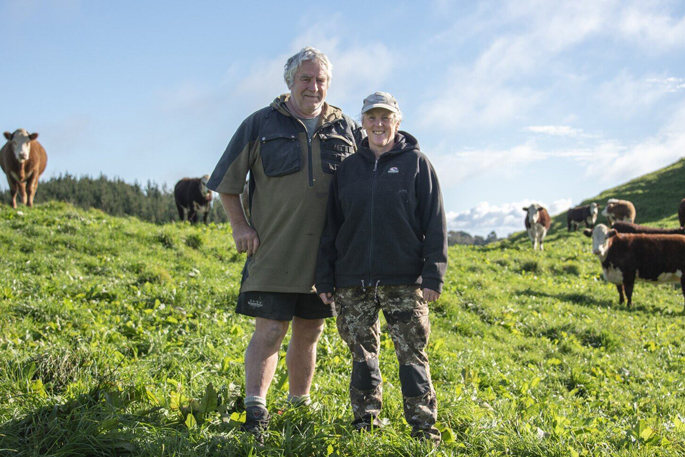
A Bay of Plenty farming couple whose cattle breeding operation has produced an extraordinary 22 sets of twins from just 180 cows have been recognised for balancing top-performing livestock with exceptional environmental stewardship.
Chrissy Weeks and Tony Lumsden were the Bay of Plenty winners of the Beef + Lamb New Zealand Livestock Farm Award at the 2026 Ballance Farm Environment Awards.
Their beef operation was described as a great demonstration of how simplicity and stewardship can benefit both livestock and the landscape, balancing high-performance animal husbandry with deep environmental respect.
With Chrissy as farm manager, the couple have run the business since 2004 for owners Jay Weeks, Chrissy’s mother, and her stepfather, Donald Johnstone. Ratahi Holdings operates across two properties: a 44ha effective block on Matakana Island, owned since 1987, and a 544ha property (270ha effective) in the hill country above Matatā, which has been the family farm since 1993.
Beef farming
“The Matatā property is mainly steep rolling country and, when you have a 250-cow beef breeding herd with larger cows, it dictates which land can be used by different mobs at various times of the year,” says Chrissy.
When the farm was purchased, the remaining Hereford stud herd became the foundation cows for the Weeks herd. Chrissy has since introduced Charolais, South Devon and Angus genetics, cross-breeding animals that fatten efficiently and grow quickly.
“We have July calving and the calves stay with their mothers until the end of March. Weaning weights are usually above 200kg, with some well over 300kg by then.”

Tony Lumsden and Chrissy Weeks run their family’s 270ha effective Matatā beef farm. Photo / Catherine Fry
The farm has a significant tick problem, with young calves particularly susceptible to theileriosis, a tick-borne cattle disease that causes anaemia and can sometimes be fatal.
“Calves are treated with Bayticol every six weeks from two weeks of age until weaning. Cows are also treated before going into winter grazing in late March and again when they come back out.
“We used to buy in 50 heifers each season, and we think the ticks were introduced by a line that wasn’t quarantined. Now we operate a closed system and breed all replacement stock on-farm. We also grow all our own supplements, so we have total control over quality and biosecurity.”
Breeding instinct
“The only time we bring in stock now is every three to four years when we buy bulls to diversify our bloodlines. We buy Herefords from Peter Davies at Charwell Stud and South Devons from Mark Eagle at Kaimoa South Devons.”
Previously, Chrissy studied catalogues looking for bulls that appealed to her. Tony says she now judges a bull on its appearance first before reading the figures in the catalogue, paying particular attention to IMF (intramuscular fat) figures, which can attract an additional premium in the offspring.
With their own calves, Chrissy makes early decisions about which 10 to 12 bulls will be retained for use as 2-year-olds and which replacement heifers she wants to keep for breeding. The remaining bulls are ringed as steers and, with the remaining heifers, are fattened for processing.
“All non-breeding cattle are fattened for a one-way trip to the works at around two years of age, and it’s important to us that they have a good life in the meantime.”

Chrissy Weeks (right) and Tony Lumsden were the Bay of Plenty winners of the Beef + Lamb NZ Livestock Farm award at the 2026 Ballance Farm Environment Trust awards. Photo / Catherine Fry
Chrissy’s approach to animal husbandry stood out to the judges for its empathy and attention to detail.
The judges noted that her high level of care has delivered tangible results, including a remarkable farm record of 22 sets of twins from just 180 cows.
“There is no pattern to it, and we have no idea why we get so many twins. Some cows have twins every year or every other year, while others are completely random.
“I’ve experimented with keeping bulls that were born as twins, but their offspring haven’t produced twins.”
One downside of twins is that the mother often rejects one calf. Chrissy milks two dairy cows using a portable milking plant and, alongside feeding their own calves, the cows can raise a further five to six abandoned calves between them.
Mating starts on October 1, with cows mated for nine weeks, resulting in a 95% in-calf rate, while heifers are mated for six weeks and achieve an 85% in-calf rate.
Environmental stewardship
The farm operates its own nursery, where the team cultivates native plants, often rescued as seedlings from vulnerable areas of the property. Chrissy personally manages pest control across 200 hectares, demonstrating a commitment that extends well beyond standard compliance requirements.
Land management is dictated by topography and climate. In winter, younger stock are rotationally grazed on a 21-day round, while cows spend eight weeks off-farm on saved feed in Ratahi’s bush blocks.

Chrissy Weeks (right) and Tony Lumsden were the Bay of Plenty winners of the Beef + Lamb NZ Livestock Farm award at the 2026 Ballance Farm Environment Trust awards. Photo / Catherine Fry
Sensitive, steep areas are grazed only once a year to minimise soil damage, while stock movements are carefully planned according to rainfall and ground conditions.
Detention bunds have been constructed to slow water flow and reduce erosion.
Chrissy and Tony were praised for their open-minded approach, embracing innovative farming practices while also welcoming regular visits from hunters and trampers.
At Ratahi Holdings, success is measured not only by beef production, but also by the long-term health of the land under their care.

0 comments
Leave a Comment
You must be logged in to make a comment.