


Bay of Plenty surf lifeguards have ensured their beaches are kept safe performing a record number of rescues this summer season due to a high number of people making the most of sublime summer conditions.
Surf Life Saving New Zealand provisional 2014/2015 statistics show between October 2014 and April 2015 there were a 348 rescues carried out across seven Surf Life Saving Clubs from Whangamata to Pukehina – more than double the number in the 2013/2014 summer period bringing with it a fatality free period.
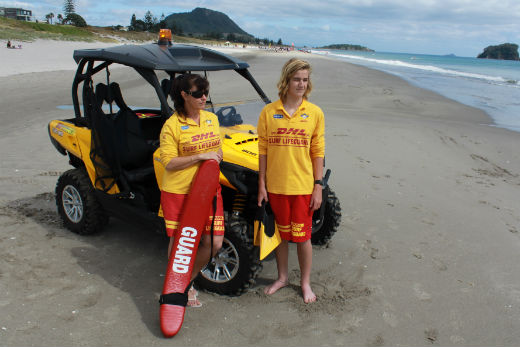
Surf lifesavers at Tay Street Beach. Photo: File.
In 2013/14 just 162 rescues were performed with Whangamata registering the highest number, 56, followed by the Mount, 54, and Omanu 17.
In 2014/15 the Mount led the way with 105, Omanu 84, and Papamoa 50. There were 50 rescues at Papamoa Beach, compared with three rescues last summer. There were 27 at Pukehina, four at Maketu, 33 at Waihi Beach and 45 at Whangamata.
According to SLSNZ a large number of the rescues performed this summer were performed in coastal areas, outside of the traditional flagged areas. More than 50 per cent of rescues were done via tube and rescue boards.
Surf Life Saving New Zealand lifesaving services and education manager Allan Mundy says it has been one of the busiest seasons on record thanks to a great weather and large numbers on the beaches.
This is coupled with sea conditions being dangerous at times, with a large number of big troughs running the length of the coast, which had fed into the rip currents.
And while he is proud of the tireless efforts of all clubs, it is the zero drowning figure adding the gloss to the season. Although there were no drownings some beachgoers are still failing to swim between the flags or over-estimating their ability to cope in the strong surf and getting into difficulties.
'I think the vigilance of the guards to prevent people getting into difficulty really paid off, we really focussed on people putting the ambulance at the top of the cliff stopping people from getting into trouble rather than going out to rescue them.
'Because once we do get into that having a rescue situation that's when it is a numbers game when we will lose people, and to everyone's credit this year we managed to make sure none slipped through.”
One key aspect Allan wants the public to take away from the season is that the majority of lifeguards are volunteers giving up countless hours on the beach to keep beachgoers safe – many choosing to continue patrolling beyond the normal 5pm clock-off time because of the large volume of people still on beaches.
'There are loads of patrols this year that went well past 7 o'clock.
'I really do hope that people understand our people are volunteers and they all are very involved in their community and family. And when it's the evening we love to get back to our families.”
Mount Maunganui Lifeguard Service general manager Glenn Bradley attributes the increase in rescues this summer to two key contributing factors.
"Firstly, a slightly better summer overall weather-wise than last year, which brought far more people to the beach, and secondly during the very busy Christmas/New Year period, the beach along the stretch of coast from Grove Ave to Clyde St/Crossroads developed a number of guts, holes and rips - more than we have ever seen in recent years."
Lifeguards had "doubled their efforts" travelling the beach on roaming patrols looking out for swimmers, amassing 8146 patrol hours this summer, an increase of 705 hours.
People were generally well behaved but there was always some people who chose not to swim between the flags and those who definitely need to learn what a rip looks like," he said.
This season the Mount's lifeguards logged up more than 5000 volunteer patrol hours, 5028, down from the previous year's 5055.
And like Allan he says out of hour patrols played a big part in the season, accounting for close to 50 per cent of all rescues.
Omanu Surf Life Saving Club patrol captain Mike Swan says lifeguards and beachgoers were presented with much more dangerous beach conditions and constant swell this season.
The longer summer and warmer water temperatures meant higher numbers on the beach, but at the same time he feels the message of water safety is slowly sinking in.
'There has been plenty of education around beaches with children leaning about how to identify rips. But you can't go past the old adage, ‘always swim between the flags', and ‘if in doubt don't go out', and swim with a friend.
'Our rule of thumb this year was keep kids within arm's reach and in actual fact we saw a lot more parents standing in the water, a lot more than previous years. I think this is an acknowledgment of an understanding of the dangerous beach conditions.”
Finalised statistics for the full 2014/15 patrol season will become available in late April.

0 comments
Leave a Comment
You must be logged in to make a comment.