


An open day to discuss options for the future of State Highway 30/ Te Ngae Road will be held on Sunday, October 31 from 10am to 3pm at Whakarewarewa Rugby Club, Puarenga Park, Te Ngae Road.
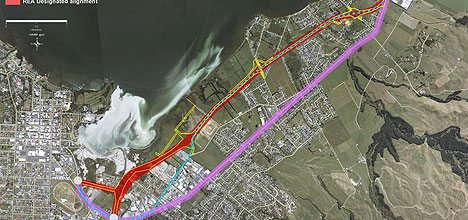
The planned options for the Rotorua Eastern Arterial.
The New Zealand Transport Agency says the open day is a chance for people to have their say about its project to improve safety and trip efficiency along an important local road and freight route.
NZTA Bay of Plenty state highway manager Rod James says traffic modelling shows the number of vehicles will increase from the current level of 37,500 per day to 50,000 within seven years, impacting on safety and congestion along the route.
'Three options have emerged as potential solutions,” says Rod.
'They include upgrading the existing highway (Te Ngae Road), developing a new highway along the designated route closer to Lake Rotorua with two new intersections at Sala Street and the proposed Victoria Street Arterial, or using most of the designated route but upgrading Vaughan Road at the western end instead of continuing the highway over the sulphur flats.”
Rotorua Mayor Kevin Winters says the project is critical for the region's development.
'The Rotorua Eastern Arterial is an important project for both our district and our region,” says Kevin.
'With the increasing volume of traffic, we need to find a way to improve safety for local residents and businesses as well as assist tourists and freight operators to move smoothly through the area.”
He says the project has the potential to help Rotorua in other ways also.
'It could open up areas of land for development that are currently restricted by already congested Te Ngae Road and support lake water quality improvement projects.
'I urge people to get along to the open day, find out about the plans and make their point of view count.”

1 comment
Peak Oil
Posted on 27-10-2010 15:04 | By The author of this comment has been removed.
The projected increase in the numbers of vehicles is based on historical trends and certainly will be proved erroneous as Peak Oil/Oil shock/the end of the era of cheap oil kicks in. I am stunned that it does not rate a mention in their calculations and projections into the future. These officials do little to future-proof us. So many experts (oil industry insiders included) have predicted Peak Oil, including the recent NZ Parliamentary report on it, that I'm dumbfounded that it does not even enter their thinking in planning and budgeting ahead. The paradigms of the past are not always helpful in predicting the future. Still those expensive, flashy new arterial roads will make nice cycleways once people start abandoning private cars as the main mode of personal transport after Peak Oil bites in the next 2 or 3 years!
Leave a Comment
You must be logged in to make a comment.