


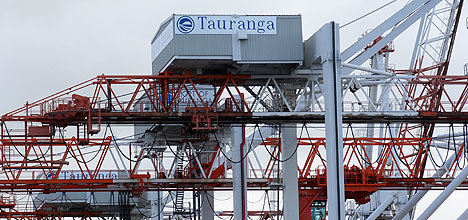
The reasons why the Port of Tauranga is the obvious choice to become the North Island port capable of handling larger 5000-7000 TEU container ships are explored in the chief executive's report to the company's annual general meeting on Tuesday.
One of Port of Tauranga's strengths is the quick turn around time for trucks.
The Port of Tauranga is awaiting an Environment Court hearing for a decision on the dredging programme to begin the expansion process.
'We've already got our dredging plans well underway with the Environment Court hearing scheduled for early next year,” says Mark.
'We can do the necessary expansion at a comparatively lower cost to other ports, in the timeframe required, and I would highlight we will do the first stage of dredging within our existing working capital.”
Tauranga is currently the only New Zealand port that can currently handle a fully-laden 5000 TEU vessel.
The largest container vessel in the New Zealand trade started regular calls at Tauranga in April. The OOCL New Zealand can carry up to 4578 TEUs.
Until now, the average vessel size calling at New Zealand ports has been less than 3000 TEUs.
The bigger ships offer economies of scale for New Zealand exporters, and a challenge for port companies. Because of the cargo volumes involved in each ship call, a port has to be able to not only physically accommodate the ships with deep enough channels, and cranes wide enough to reach across the ship, but each ship call will stretch existing cargo marshalling areas and transport corridors.
A New Zealand Shippers Council investigation into the issue firmly recommends Tauranga as the North Island hub port, a report Mark Cairns wholeheartedly endorses.
'Our best-in-class productivity, strategic land holdings, excellent road and rail connectivity, cargo diversity, and financial strength are some of the many reasons that Port of Tauranga is the obvious choice to lead the investment required to accommodate the larger ships that will visit New Zealand,” says Mark.
'And we're pleased this logic has been recognised by the New Zealand Shippers Council in its long-awaited and well-researched report into New Zealand's international supply chain and readiness for larger more efficient vessels in the 5000 to 7000 TEU range.”
The New Zealand Shippers Council represents the New Zealand ports' customer base, and more than half of the country's major exporters. Their report recommends the expansion should be done in the next five years.
'We are already providing an efficient alternative delivery point for imports, with our direct rail link to MetroPort in South Auckland, and to the Waikato,” says Mark.
'Because we are the largest bulk port in the country, we can leverage off our existing infrastructure and strategic land bank. We have a stable political environment and none of the urbanisation pressures faced by other ports.
'We've got a real opportunity here to increase the efficiency, reliability and cost-effectiveness of our supply chain infrastructure, allowing our importers and exporters to remain profitable and internationally competitive - and avoid the chance that shipping companies could choose to use Australian ports as regional hubs.”
Consolidation in port calls is already happening on the New Zealand coast.
Most recently, the main North Asia container service ceased direct calls at New Plymouth, Wellington and Nelson. Instead it will use Pacifica Shipping to provide a scheduled coastal shipping service which will hub through Tauranga and Auckland.
'Other shipping lines will introduce larger ships in the coming year, and we expect further consolidation on hub ports, with greater reliance on rail and coastal shipping,” says Mark.
'One of the challenges that these larger ships bring is the need to move much larger volumes on and off wharves, and it is here that Port of Tauranga really has strengths.
'We remain the most efficient port in Australasia, as measured by the Australian Productivity Commission. Our net crane rate over the year averaged a rate of 35.1 moves an hour.
'Truck turn times through our terminals averaged below 15 minutes at Sulphur Point and MetroPort – well ahead of other ports. We've just doubled the number of truck lanes at MetroPort to accommodate increased traffic to the terminal. We have the space and excellent transport links required to handle larger cargo volumes.”
Additional capacity is also available on the rail link between Tauranga and South Auckland. Kiwirail has committed to increasing the number of trains to up to 12 per day, and is increasing the length of trains by up to 40 per cent over the next few years, as track capacity is improved and new locomotives are introduced, says Mark.
KiwiRail is also investing in track reliability with its new $25 million track maintenance fleet working on the Hamilton-Tauranga rail link.
'We're also backing the Shippers Council call that as much as possible of the government's $750 million investment in KiwiRail over the next three years goes into the key freight routes.”

1 comment
pollution solutions?
Posted on 27-10-2010 11:03 | By claypole
Are there facilities in place to cope with a ship grounding because if the fiasco surrounding last weeks 50ft grounding on the main beach is anything to go by, I would hate to see the reaction to anything larger!
Leave a Comment
You must be logged in to make a comment.