


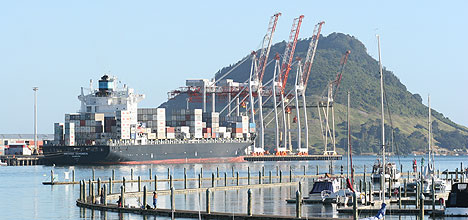
In the year ended June 30, Port of Tauranga Ltd increased earnings and profits without passing on cost increases to customers chairman John Parker told the company's annual meeting in Tauranga on Tuesday afternoon.
Underlying earnings after tax for the year ended 30 June 2010 were $49.403 million – an increase of 9.3 per cent on last year's record profit.
This was earned on revenue of $148 million – up $4.4 million on the prior year.
'We have only twice reported a net profit slightly lower than the previous year,” says John.
'The increased earnings are especially meritorious given the decision to support our customers through a difficult period by deferring any increase in tariffs during the year.
'To consistently produce such good results takes a great deal of work from excellent staff and this is never taken for granted. We have great staff and they stay with the company.”
The board of directors declared a final dividend of 20 cents per share, on top of the interim dividend of nine cents per share, bringing the year's total dividend to 29 cents per share – an increase of 7.4 per cent on last year.
The change in law to reduce the tax depreciation on buildings to zero per cent impacted reported accounts, says John.
The change created a difference between the tax value of a building and its book value. International accounting rules require the liability be reported in the profit and loss statement.
It has produced a one off non-cash adjustment to income tax of $10.5 million, resulting in a reported net profit after tax of $38.016 million.
It is over $10 million less than the underlying earnings, but there will be no change to actual tax payable until 2011/2012. The extra tax will be about $0.4 million a year, which John says will be more than offset by the company tax rate reduction to 28 per cent which will reduce the PTL tax bill by about $1.4 million a year.
A rise in replacement cost of wharves and hard standing has seen the Port of Tauranga property assets increase in value by $31 million during the year.
'We have also managed to renegotiate our debt out to 2013 to 2015, at very favourable terms,” says John.
'As a result, we continue to have one of the lowest costs of funds of any listed company in New Zealand.”
John believes Tauranga is the logical choice for the North Island hub port – the port to which the large 500-7000TEU container ships will call in future.
'The government has essentially said that it will remain neutral and allow economic forces to cause or force change,” says John.
'We have no objection to this, but still believe some local body port owners resist economic logic at the expense of their long-suffering ratepayers.
'I guess we just need to keep pointing out the gain to be had by all exporters, importers, the environment and ultimately all New Zealanders.
'We don t advocate the closure of any ports, nor do we advocate stopping port investment, but we certainly agree with the Shippers Council that there needs be a port hierarchy for containers with secondary ports putting their containers through a very small number of primary ports. We argue that two is the sensible number.”
The port's application for dredging consents to take the bigger ships is before the environment court, awaiting the hearing of three appeals.
'While this introduces delays, we are optimistic that the consent will be granted,” says John.
'To be clear, obtaining the resource consents means we will be dredging forthwith.”
Looking forward John says the economic recovery is going to be long slow and patchy.
'We are exposed to both internal and external factors,” says John.
'Taking China as an example, and it's an important example for this port, some experts predict consistently rising growth while others forecast a big downturn as a result of a bursting housing bubble.
'However, we have a very strong balance sheet, a reasonably diversified business and are ready to take advantage of any opportunity – whatever its economic origin.”

0 comments
Leave a Comment
You must be logged in to make a comment.