


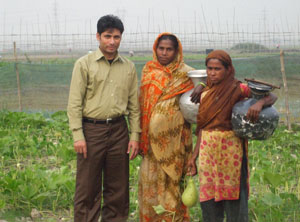
Zahirual Alam spent the last three months planting the seeds of Project Green in his homeland, Bangladesh.
| Project Green co-ordinator Zahirual Alam with Bangladeshi farmers who do not have irrigation systems. These women must cart all the water needed for their fields from a nearby pump. |
The award-winning project was originally started by Bangladeshi Community Tauranga Inc. two years ago to encourage Western Bay of Plenty families to eat and grow their own fresh fruit and vegetables.
Currently 12 schools and early childhood centres as well as many families in the region have set up their own gardens with Project Green's help.
Alam has also had requests to help set up a similar project in cities around New Zealand, however a lack of funding means he is currently focusing on the Bay of Plenty. However the family trip to Bangladesh provided the chance to take the Project Green idea international.
Alam says despite growing enough fruit and vegetables to feed their families and supply local markets, Bangladeshi farmers do not know how to set up gardens with neat rows for optimum efficiency. Instead plants are left to grow wild in large fields without proper irrigation.
In a poor country like Bangladesh, caring for the environment is often seen as a low priority. Most farmers use chemical fertilisers rather than organic methods. They do not understand the importance of thinning, pruning and providing support structures, and how this can benefit produce quality. Farmers also lack tools and equipment most New Zealand gardeners would take for granted.
'They need people to teach them how to do it better,” says Alam.
While in Matuail, near the capital Dhaka, and in his former village of Katranga, Alam visited farmers and taught them new techniques, many of which he first learnt while working in the kiwifruit industry here in the Bay of Plenty.
'I tried to set a good example. I told them it will be much more profitable at the markets but at first they wouldn't let me thin their plants. So I told them ‘if you lose, I'll pay you back'. I came back three weeks later and they were very happy and six weeks later they were selling their vegetables for more than the normal prices, sometimes up to double the price.”
Alam believes there are opportunities for New Zealand to work with Bangladesh to develop its horticulture industry for export.
'They don't have anything like Zespri and they don't have export opportunities like New Zealand. I was also very sad for the environment there. We are very lucky here in New Zealand.”
He also visited schools where he told them about winning an Environment Bay of Plenty Environment Award and a Community Spirit Award for Project Green.
'I told them how if you do a good job, you will get rewards.”
Everywhere he went he also shared his love for New Zealand. Alam has lived in NZ since 1996.

0 comments
Leave a Comment
You must be logged in to make a comment.