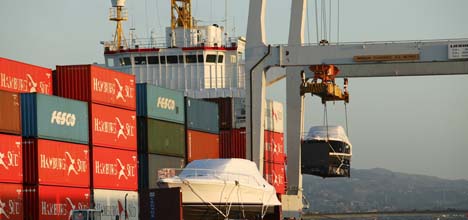
The pace of New Zealand port rationalisation is likely to be forced by overseas events, says Port of Tauranga chairman John Parker in his report at the Port of Tauranga Annual Meeting this week.
The ports of Tauranga and Auckland are jockeying for the position of major New Zealand hub port, a situation being forced by the spill-over from overseas routes of containerships that are too big for New Zealand ports at present.
Port of Tauranga.
These ships, about 300m long and capable of carrying 6000 TEU (20 foot equivalent units) will be here sooner than expected says John.
'There has been a huge increase in container ship building over the past decade, driven by increases in global trade and the efficiencies of the newer, larger vessels, whose costs per container are lower by some 30 per cent,” says John.
'World trade diminished substantially with the collapse of financial markets and there is now a surplus of container ships with an estimated 20 per cent of
container capacity likely to be idle by the end of 2009.”
The problem is exacerbated for ship owners, because new ships are getting bigger. Ships under construction will increase capacity by an estimated eight per cent in 2009 and 10 per cent in 2010.
'Without a very big turnaround in global trade in 2010, which I suggest is unlikely, the surplus of container vessels could well double,” says John.
'The move to newer and bigger ships was happening anyway but is accelerated by the surplus of tonnage and the obvious desire of ship owners to idle their older, smaller and less efficient container ships.”
Major Port of Tauranga customer Fonterra estimates annual savings to New Zealand of $2 billion to $3 billion per annum should larger container ships be introduced to our shores, says John.
Producers, consumers, exporters and importers would benefit substantially. The cost of national infrastructure that taxpayers bear in road and rail would also decrease.
'Currently, no New Zealand port, despite the occasional and deluded denial, can handle the larger vessels already wishing to enter the New Zealand trade,” says John. 'Until they can, the savings cannot be realised.”
It's not just the physical restraints of lack of channel depths, lack of berth size, lack of sufficient container cranes and straddle carriers and lack of the port land to handle large loads and discharges that are holding back progress. 'Most New Zealand ports have negative free cash flow and are being subsidised, in some cases very heavily, by their long suffering ratepayers so can't afford the required investment,” says John.
'But even if they could, there is no possibility of more than two hub ports making the investment economically sensible. And these big vessels,
to realise the economies they offer, will only load at one or possibly two ports in New Zealand.”
In a rational world, the economic ports would buy out the weak, says John, or at least the weak would go out of the container business because the returns were so poor.
Unfortunately, New Zealand ports are in many cases totally controlled by local government owners whose drivers are not necessarily economic and the ratepayer owners, even if they understand the costs to them, feel powerless to intervene.
'New Zealand simply has too many ports,” says John. 'Most with negative free cash flow, while at the same time they are increasing capital expenditure to try and keep their infrastructure up to date.”
The rationalisation process can be helped along with a nudge or two, says John.
Insisting that ports meet the criteria laid out in the Port Companies Act where ports are required to operate a successful business would give some focus.
'Not achieving a cost of capital could hardly be defined as successful,” says John.



06-Nov 18:00
Wairoa Bridge cycleway fully closes from Monday
06-Nov 17:00
Two-way traffic returns past gorge's biggest slips
06-Nov 16:00
Weekend events postponed due to rain
06-Nov 14:00
More than 10,000 people expected at Sika Show
06-Nov 12:10
Bay of Plenty on alert for severe thunderstorms
06-Nov 11:45
Coromandel beaches restrict dogs at peak times
06-Nov 11:12
Ōmokoroa: $13m road project adds four lanes
06-Nov 10:00
Allan clocks up 60 years with Katikati brigade
06-Nov 08:03
A ‘lifestyle block on steroids’ in Karangahake
06-Nov 07:00
Tauranga hosts NZ-India sport centenary fest
05-Nov 18:00
Western Bay weighs charges for granny flats
05-Nov 17:00
Man suffers life-altering injuries in Mount attack
COMPETITIONS

0 comments
Leave a Comment
You must be logged in to make a comment.