



As New Zealand's economy continues to slug it out after a long period in recession, fallout from the tough times appears to be taking shape as some workers begin to move against the wage freezes, increased workloads and low morale they have tolerated for the last two years.
New Zealand entered recession at the start of the financial year in 2008 when it recorded its first quarter of negative growth. The economy's growth since then has continued to be negative until the latest quarter when it was measured at 0.1 per cent. This degree of growth was within the margin of error of the measure so New Zealand's economy continues to be tenuous.
There appears to be an increase in the amount of industrial action around New Zealand and the Bay of Plenty is no exception.
Tauranga Hospital food and service workers have picketed for a pay rise, a lockout and striking situation has taken place at the Waharoa cheese factory, staff at the Bay of Plenty Polytechnic have undertaken a programme of rolling strikes and Ministry of Justice employees are ‘working to rule'.
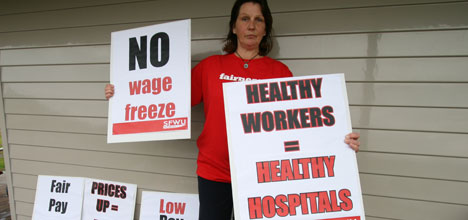
Christine Rapana a Tauranga Hospital worker who protested for a wage increase on Friday. Picture by Tracy Hardy.
Tauranga Chamber of Commerce CEO Max Mason says there are a variety of reasons for the industrial action at the moment.
'A change of government, Labour to National, historically is followed by some industrial action. This can be for ideological reasons, or because the new government introduces change. Few people like change and it is often resisted,” says Max.
Much of the recent industrial action is from the public sector, which Max says is not surprising.
'As a general principle I think that, as many sectors of the economy have had to make sacrifices, and as wage restraint is evident in many commercial businesses, the public sector shouldn't be any different.”
Max is appreciative of the situation that many workers are struggling with though.
'It's not fair that many people aren't getting increases when costs are increasing, but that's the reality of the situation – at least inflation is very low which helps a little.”
Industrial action is not something that happens overnight. Taking such serious measures is usually the result of failed or stalled terms of employment negotiations. In times of financial hardship, when workers' demands cannot be satisfied, Max says it is important for employers to maintain strong lines of open communication with staff.
'Employers need to empathetically listen carefully to staff and ascertain if the unease is just about money.”
Max says managing these complicated situations can be about being creative in solutions and sometimes more money is not the answer.
'There are always creative solutions such as extra time off, job sharing, or guarantees of future employment – if certain financial measures are achieved.”
The full burden does not lie on employers to resolve these situations though and Max says it's important for workers and unions to recognise the difficulties a business may be going through owing to recession.
'Unions may also need to show leadership and show their members why action in difficult times is not warranted. It's not business as usual and all involved may need to change their expectations.”
Max says the main reason industrial action tends to take place is when there is a communication breakdown, which is a problem as a collaborative approach is the best.
'Employers should not lose sight of the fact that solutions are often best found amongst the staff.”

0 comments
Leave a Comment
You must be logged in to make a comment.