


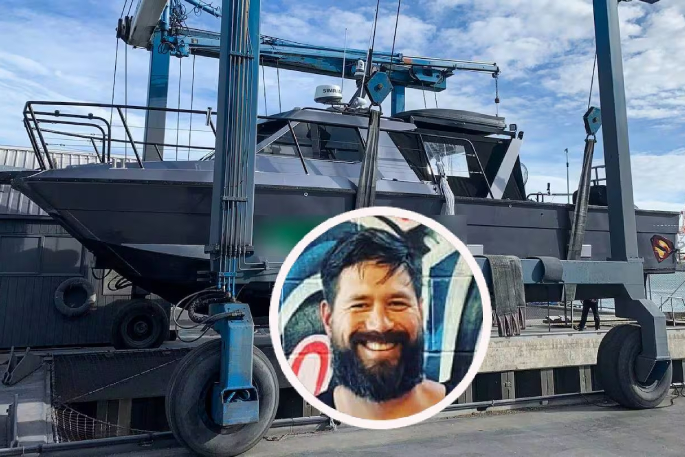
For five years, the Royal New Zealand Navy tried to impress upon Darren Miini Kerekere Katipa – a warrant officer from Rotorua with a high security clearance and some unsavoury associates – that he was no longer wanted.
The career military man first came under fire after disclosing in 2019 that a friend had been the subject of a high-profile arrest for what would later be revealed as a massive 138kg of meth bust worth over $100 million.
His security clearance was suspended the following year, citing the disclosure, and he was barred from Navy facilities. But he appealed to the Vice Chief of Defence Force and was reinstated in April 2021 due to “insufficient evidence currently available”.
Less than two months after his reinstatement, efforts to expel him were renewed when Katipa was himself arrested – along with former Lotto presenter Russell Harrison and numerous others – and accused of participating in the same drug syndicate as his friend.
It was alleged he had participated in an organised criminal group that answered to the “supreme commander” of the Comancheros and plotted to smuggle 1.5 tonnes of cocaine into New Zealand.
Katipa again resisted as his commanders tried to expel him from the service under an “undesirable discharge”, which he argued amounted to an illegal punishment for unproven allegations. Last year, the employment battle ended when a Wellington High Court justice sided with Katipa, allowing him to retire on his own terms without the “undesirable” stigma.
But last week, as he appeared in the High Court at Auckland for sentencing, his run of luck with the courts finally ran out.
The 47-year-old was told by Justice Michael Robinson there was no possible way his sentence for the cocaine scheme could be anything but imprisonment, despite a letter-writing campaign by his supporters who described him as a devoted father of four, a community volunteer and someone with the potential to be a future iwi leader.
He was ordered to serve three years and 10 months’ imprisonment.
“That end sentence reflects ... that drugs of this sort wreak havoc in our community, and those who are convicted of offences such as this will be met with significant sentences,” the judge explained, wishing Katipa well as the hearing ended.
“A great injustice has been done here today,” a supporter said loudly as the courtroom emptied a few minutes later, after the judge had left the bench.
An audacious plot
Had it succeeded, it would have ranked as New Zealand’s largest ever known cocaine import – more than 30 times greater than any other seizure at the time.
Prosecutors said the scheme was hatched in October 2018 to collect three 500kg shipments of the drug from a mothership about 320km off the coast of Tauranga.
Comancheros international leader Duax Ngakuru, a Rotorua native who climbed the ranks of the outlaw motorcycle gang in Australia before fleeing to Turkey, had established the drug syndicate during a visit to New Zealand a year earlier and ran it from overseas, it was alleged.
His main lieutenant on the ground in New Zealand was his cousin, Justin Te Kowhai, who was in turn a cousin of Katipa.
Authorities allege Ngakuru bankrolled the effort, which included spending $280,000 to purchase and kit out a retrieval ship dubbed “Kryptonite”. But Katipa played an integral part, offering advice on which boat to buy, how to upgrade it and what it would be capable of. He was recruited to form the ship’s four-person crew.
“You were selected on account of the specialist nautical and marine expertise that you have acquired during your long career in the Royal New Zealand Navy,” Justice Robinson explained last week.
“You advised on things such as fuel requirements, engine configurations and maximum vessel weights. You researched and sourced specialist camera and radar equipment. You were involved in the sea trials and planning exercises.”
The import scheme forged ahead even after fellow crew member Lionel McDonald, the friend Katipa later told his commanding officers about, was arrested in August 2019. But the boat was ultimately never used “as far as is known” in any importations, according to court documents for other defendants.
“After Mr L McDonald was arrested in August 2019, there were likely some fears of the crew being compromised by a police investigation,” the agreed summary of facts for Te Kowhai states.
Those suspicions would have been correct, although they wouldn’t be confirmed by Katipa, Te Kowhai and others until their own arrests two years later.

Rotorua resident Justin Te Kowhai appears in the High Court at Auckland for sentencing in September 2026 after admitting his participation in a major drug syndicate. He was arrested following a multi-year investigation dubbed Operation Van. Photo / Michael Craig
The Police National Organised Crime Group had been surveilling the syndicate for years in an investigation called Operation Van.
The case was given a major boost thanks to an audacious global investigation dubbed Operation Trojan Shield, in which criminals around the world were duped by the FBI and the Australian Federal Police into using ANOM, a supposedly encrypted messaging service that had been promoted specifically to the criminal fraternity. In reality, the service was funnelling communications to law enforcement in real time.
Although a subordinate to Te Kowhai, Katipa would have been aware of the scale and the nature of the massive importation and appeared to be motivated to go through with it for financial reward, his sentencing judge said.
‘Incompatible with NZDF mana’
Katipa joined the Navy in 1997 and was deemed to have “performed to a high level” in the decades that followed, earning a spot as a combat systems specialist with “secret” security clearance.
As was required for such a security clearance, he reported to his superiors a “change of circumstances” in August 2019 after claiming to have learned of his friend’s arrest in the newspaper.
“I have known him for at least 3-4 years through family, becoming friends in the last 12 months because of a shared interest in fishing and boating,” he wrote of his affiliation with Lionel McDonald. “During the last 12 months I have seen him about once a fortnight mainly around boating and fishing. I have had drinks with him, in Rotorua at bars and at family gatherings. I had considered him a friend.”

Lionel James Ruka McDonald at his sentencing hearing. Photo / Stephen Parker
He said he ceased contact after learning of the arrest.
In September the following year, the Directorate of Defence Security suspended his security clearance and barred him from Navy facilities, deeming him “unsuitable to hold a national security clearance at any level” and accusing him of “behaviours [that] do not align with NZDF values, specifically integrity”.
“… Subsequent enquiries ... indicated that WO Katipa’s relationship with McDonald, and likely others, was more substantive than what he declared," the directorate report read.
Katipa was reinstated on appeal seven months later, in April 2021. But he was suspended again on June 8 that year, one day after his arrest.
By January 2024, the case against Katipa was still lingering in the justice system – an uncommonly long wait for a trial – due to challenges over the legality of the ANOM app. The Navy decided to seek an “undesirable” discharge for Katipa despite what was described as an otherwise successful military career.
It was noted in the decision that criminal charges can only be laid where there is “sufficient evidence to support a reasonable prospect of conviction”. The charges against Katipa were so serious as to “significantly undermine the trust and confidence that command can place” in him, the report said.
The following month, Katipa requested that he instead be allowed to retire from the Navy to avoid the stigma and loss of potential entitlements based on length of service that would result from an “undesirable” discharge. But his commanders persisted, emphasising that the allegations were “the antithesis of the NZDF’s core values” and had already brought the Navy “into disrepute”.
“I conclude that WOCSS Katipa’s conduct, over a period of time, is not only incompatible with the mana and leadership expected of a senior rating, but has shown a level of disregard for the discipline of Service life so as to indicate his unsuitability for continued service,” then-Acting Chief of Navy Karl Woodhead wrote of the decision.
But the decision was overturned in August last year by High Court Justice Cheryl Gwyn, who noted that none of Katipa’s commanders had consulted with prosecutors or police about the pending charges.
“I conclude that Mr Katipa did not have sufficient information to effectively refute the allegations against him,” she wrote. “...The discharge amounted to an unjustifiable limit on Mr Katipa’s right to natural justice.”
‘A blameless life’
Nearly a year later, the jury trial for Katipa and his co-defendants was finally ready to begin in the High Court at Auckland. However, all but Katipa ended up pleading guilty in the weeks and days before the trial began.
Jurors, who were given transcripts of Katipa’s conversations about the cocaine retrieval boat, found him guilty in July.
He faced a sentence of up to 14 years’ imprisonment for conspiracy to import cocaine.

Crown prosecutor Ben Kirkpatrick. Photo / Michael Craig
Crown prosecutor Ben Kirkpatrick acknowledged that Katipa was a subordinate in the import scheme, but he emphasised that the defendant’s logistical contribution was more significant than others due to his “maritime knowledge that was acquired during 20 years of service”.
Defence lawyer Todd Simmonds, KC, said his client’s involvement in the scheme had been “sporadic”, with weeks or sometimes months lapsing between related conversations.
The lawyer also argued there were significant and compelling mitigating factors, including Katipa’s “many years of outstanding service to the Royal New Zealand Navy”.
“He is fundamentally a good person – a good family member, a good worker, someone who actually has his head screwed on,” Simmonds said. “And he finds himself today in his darkest moment, acknowledging the verdict of the jury and here before you for sentencing.”
But Simmonds acknowledged that Justice Robinson really didn’t have any choice other than prison given the way drug import sentences are structured in New Zealand.
The judge agreed, even though he noted that Katipa had been assessed as a low risk of reoffending.

Justice Michael Robinson in the High Court at Auckland. Photo / Michael Craig
He ordered a starting point of six years before allowing 35% in discounts for prior good character, the impact of imprisonment on his children and the years he spent on bail awaiting trial. The end result fell well short of the two-year threshold at which a judge can consider a non-custodial alternative.
“Before your involvement in this offending at approximately 40 years of age you had lived not only a blameless life, but a very positive one,” the judge noted.
“Your Navy career has been a significant contribution to our community, although the Crown clearly points out that I must not lose sight of the fact that it was those naval skills that you contributed to your involvement in the conspiracy.
“...Your offending reveals a serious lapse in judgment, clearly out of character. Your defending does not define your character or the contribution you have made to your community.”
10 sentencings
Katipa’s sentencing was the final of 10 arrests and convictions that have resulted from Operation Van.
A pair with ongoing interim name suppression accused of having acted as the bank for the syndicate – handling nearly $8 million – were sentenced last month for 15 charges of money laundering and one charge of participating in an organised criminal group. A woman was sentenced to 12 months’ home detention while a man was sentenced to two years and eight months’ imprisonment.
Katipa’s cousin, Te Kowhai, was also sentenced last month, receiving a sentence of 17 years and four months’ imprisonment. Four others received sentences of home detention that same day: TV personality Russell Harrison, who helped deliver $400,000 in gold bars to Turkey, former Bay of Plenty Comancheros leader Pomare Pirini, Carlo Gear and Jack Phillips.

Former Lotto presenter and musician Russell Harrison appears in the High Court at Auckland for sentencing after admitting to laundering over $400,000 for a Comancheros-led drug syndicate. Photo / Corey Fleming
Lionel McDonald, the person whose arrest Katipa first reported to his supervisors, is serving two sentences for drug importation totalling 14 years and nine months.
Another man with name suppression who served as the banker for the syndicate before the other two people with name suppression was sentenced in 2022 to nine years’ imprisonment.
Alleged kingpin Duax Ngakuru was arrested in 2023 in Turkey. He remains outside New Zealand.
Craig Kapitan is an Auckland-based journalist covering courts and justice. He joined the Herald in 2021 and has reported on courts since 2002 in three newsrooms in the US and New Zealand.

0 comments
Leave a Comment
You must be logged in to make a comment.