


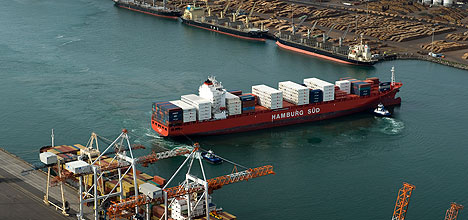
A $295,000 report showing the Port of Tauranga is set to get busier in the next 30 years, raised questions when it was tabled for discussion at Tauranga City Council yesterday.
Commissioned by the Upper North Island Strategic Alliance in June, the report reveals that all three ports - Northport, Auckland and Tauranga - need to grow to cope with the volumes of freight expected to be exported and imported from the upper North Island region in the next 30 years.
The Port of Tauranga is expected to grow in the next 30 years.
'From our perspective what it does say is we are going to grow quicker than the other two,” says Mayor Stuart Crosby.
The Strategic Alliance includes territorial authorities from Tauranga City, Hamilton City, Auckland and Whangarei as well as the regional councils from Waikato, Bay of Plenty and Northland.
The report's findings will have ramifications for the New Zealand Transport Agency and KiwiRail, as the Port of Tauranga's growth may be affected by transport issues arising outside the Bay of Plenty.
TCC strategic planner Andrew Mead says capacity constraints are already emerging in the rail network in Auckland, which affects trains to and from the Port of Tauranga's Metroport in Penrose.
A dedicated freight track is being considered.
One of the certainties to come out of the UNISA study is that for Tauranga it will mean more trains and longer trains. The increased number of trains required will mean KiwiRail will need to build more passing loops and even consider double tracking the Kaimai Tunnel.
The report says it may also raise 'reverse sensitivity' issues from communities close to the rail network due to noise and frequency issues associated with trains.
Stuart says the Price Waterhouse Coopers Auckland-centric report has been paid for largely by the Auckland membership due to concerns about Ports of Auckland's future.
'They are having a huge debate about whether they should turn the Waitemata into a river,” says Stuart.
The study, which began in June, was designed to build a common understanding of the current and future freight demand for ports and port-related infrastructure in the upper North Island, scenarios to meet the demand and the potential implications.
A total of 53 per cent of New Zealanders live in the upper North Island and that is expected to grow to 59 per cent by 2041.
The population of the UNI is expected to grow from around 2.3million in 2011, to 3.3million in 2041. Auckland is expected to account for around 40 per cent of the country's population by 2041.
The UNI currently generates an estimated 53 per cent of New Zealand Gross Domestic Product. In industries, such as the wholesale trade sector, the UNI has 66 per cent of GDP.
The three UNI ports handled 45 per cent of New Zealand's total freight export weights in 2012, with 30 per cent of national export weights shipped through Tauranga. Sixty eight per cent of the imports came through the UNI ports.
Key findings from the report include:
• Annual tonnage growth across the upper North Island port network of 1.7% - 2.3%
• Although the port network can meet future demands, it needs to become more efficient (particularly in container trade) and incremental investment in infrastructure is necessary, including the completion of consented works
• The Port of Auckland is likely to face capacity constraints ahead of the other ports, which will require a range of possible responses
• Pressures on land transport infrastructure are likely to be less than those on port infrastructure due to the growth in transhipping (when cargo is offloaded at a port and loaded directly onto another vessel)
• Any substantial changes to the configuration of the upper North Island port system would have significant costs that would likely outweigh the benefits.

0 comments
Leave a Comment
You must be logged in to make a comment.