


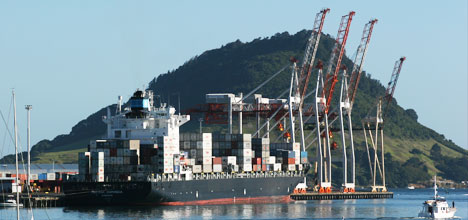
The Port of Tauranga Sulphur Point container terminal is now the largest container terminal in New Zealand, says Port of Tauranga chief executive Mark Cairns.
In his report to the company's annual meeting, Mark says container volumes during the year increased 35 per cent to just under 800,000 containers.
Port of Tauranga. File pic.
Assuming the majority of the growth in container traffic is due to the extra containers handled as a result of the industrial action at the Ports of Auckland at the beginning of the year, is incorrect says Mark.
'Most of the additional cargo is due to the seven new shipping services introduced to Tauranga during the financial year,” says Mark.
'Less than a third of the extra containers were as a result of the Auckland industrial action, and more than 200,000 containers came from the new services.”
Containerised cargo now makes up 48 per cent of the cargo handled by PTL, up 40 per cent on last year, and now provides a more diverse cargo mix, further improving the port's risk profile against commodity fluctuations.
Transhipment containers increased by more than 88 per cent during the year, evidence of the structural change occurring in New Zealand ports with a move to hub and spoke ports.
Transhipment is where containers are transferred from a ship into the container terminal and then out of the terminal again, usually onto a larger vessel.
'Such significant transhipment growth tangibly demonstrates our position as New Zealand s hub port for international trade,” says Mark.
A surprising nine per cent of the transhipment containers originated from Australia and then transhipped over to Port of Tauranga and onto export markets in the northern hemisphere.
Business partner KiwiRail experienced an increase in container traffic between Tauranga and Auckland of 33 per cent to 183,000 during the year, partly due to the diversion of extra volumes related to the Auckland industrial action.
'The on-going volumes due to new services has been enough for KiwiRail to increase train capacity to and from MetroPort - from four to six trains per day, carrying up to 636 containers per day each way.
'We are pleased KiwiRail has also continued with significant investment on the East Coast Main Trunk line and from early 2013, all major infrastructure constraints for growth will have been removed and we will have the capacity to run fifteen trains per day, each way, to cater for future demand.”
Log exports from the Mount Maunganui side of the harbour also continue to show solid growth.
Logs handled increasing by 11 per cent to 4.9 million tonnes, and total forestry product exports increased by nine per cent.
More than half the logs exported from Tauranga are going to China.
Dairy product exports more than doubled, increasing by 126 per cent during the year.
Frozen meat exports increased by 38 per cent, apple exports were up 164 per cent and steel by ten per cent.
Kiwifruit volumes held up through the port over the financial year, showing a small increase of one per cent, but reduced volumes are expected over the next few years.
'We feel for the many kiwifruit growers in this region, who are experiencing the devastating impacts of PSA.”
On the bulk imports side, oil products, other liquids, fertilisers and stock feed supplements remained steady overall.
There were 83 cruise ship visits during the season, and the port is expecting a similar for the coming season.
Recognition of the Port of Tauranga's international standing comes from the New Zealand Productivity Commission's report into international freight transport, which was released in April.
'We were found to be the highest performing New Zealand port for container productivity, and the Commission also noted that we were in the upper-decile when benchmarked against other ports internationally.”
Congestion at the container terminal during the period of Auckland industrial action did cause crane productivity to fall to 31 moves per hour, but the port managed to restore this to more than 35 moves per hour again over the last two months.
'We won't keep the new shipping services that we are attracting unless we can maintain the class-leading productivity and customer service that brought them to us in the first place.
'To that end, we are investing further in the people and equipment we need as we undergo a significant expansion programme. We have invested $39 million over the last financial year and plan a further $180 million investment over the next three years, which will be largely funded out of operating cashflow.”
The port has ordered two new gantry cranes. One is arriving early in 2013 and the other in 2014, bringing the Sulphur Point line up to seven.
'We have also modified one of the older cranes to become twin-lift capable.
'We are very excited about the potential that is being shown in our twin-lifting trials, with peak crane rates of more than 60 moves an hour being achieved.”
The port is also upgrading and modernising the straddle carriers, six were bought during the last year with another six being delivered in 2013. They are configured for twin-lift capability.
The new equipment is part and parcel of the 170m Sulphur Point wharf extension due for commissioning in March 2013.
The extra 170 metres of wharf will increase berth capacity by 28 per cent, and combined with the additional cranes, will provide significantly greater berth window flexibility for port customers, says Mark.
'We have spent a lot of time ensuring that the space at the existing terminal is optimised and, with some reconfiguration, we managed to increase container ground slots by some 30 per cent, and refrigerated container plugs by 40 per cent.
'We are currently developing a further additional 15 per cent in ground slots which will give us the ability to respond to any future short term growth in trade.”
Rail sidings at Sulphur Point have also been re-organised, allowing the loading and unloading of three trains at any one time.
New terminal operating software is being installed early next year, which will further assist in streamlining Sulphur Point container operations.
The port has also embarked on a joint venture with Ports of Auckland to implement a single container management portal called PortConnect.
'Meanwhile, we continue to work on infrastructure for our biggest export customer, the forestry industry, who are also experiencing unprecedented demand.
'While we have a lot of land allocated to log storage, the log export industry continues to export record volumes and demand additional storage. In 2012, we demolished a shed to create an additional 2.5 hectares of log storage. We will continue to pave further log storage areas in the coming year.”

2 comments
Largest port in NZ
Posted on 27-10-2012 17:54 | By Glen Clova
I notice there is no mention of the workforce, who without their input you would not have got where you are .A wage increase and Christmas bonus would not go amiss.
KIRRIE
Posted on 28-10-2012 16:39 | By PLONKER
You missed this part "... investing further in the people and equipment we need ..." would seem that PoT have everything is hand and the people are well looked after.
Leave a Comment
You must be logged in to make a comment.