


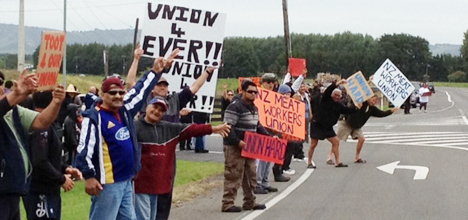
Up to 200 meat workers at the Rangiuru Affco plant outside Te Puke will be back on the picket lines on Tuesday as Affco plans to lock out workers.
The industrial action is part of a nationwide lock out by Affco owner Talleys, which started last Wednesday at other North Island plants.
Affco meat workers striking on Friday.
The Meat Workers Union shed official at Rangiuru, Kaipara McGarvey, says about 200 workers are being locked out, and a similar number will be striking in protest of the lock-out.
Kaipara says 213 men have been locked out of the Raniguru plant – about half the union membership there.
About 200 people are expected to still be working at the Rangiuru plant on Tuesday.
'The company has refused to give us any information on how many members are paying,” says Kaipara.
'We don't see any list. The company has stopped us talking to members, stopped us putting notices on the board. It's very hard to see who wants to be in and who wants to be out.”
Lock outs started last Wednesday at Affco plants in Moerewa, Horotiu, Feilding, Whanganui and Wairoa.
Union workers at the Rangiuru plant joined the ‘solidarity' strike on Friday.
No workers have been locked out at Wiri and Napier, which are both fully unionised.
Kaipara says the company initiated the indefinite lock out, claiming 18 months of disputes over the collective contract.
The collective contract expired on December 31, and so far there have been a total of 10 hours of face to face negotiations.
'Within that 10 hours the company has come to the view that the union has not wanted to settle an agreement with the company,” says Kaipara.
'The company been saying they have been disputing with us for 18 months about the collective. That's rubbish. What they have been doing is not honouring the core collective that's been in place for that 18 months.
'It's not a money issue. We had a collective in place for a good number of years and it's worked up until the last couple of years.”
The company says it wants flexibility, and Kaipara says that is exactly what they have got at Rangiuru.
Kaipara says Rangiuru workers have signed agreements allowing changing hours when stock numbers are not there and they have changed working hours and start times for bobby calves.
'We change our shift hours and the company says we don't negotiate.
'This plant does and always has – in fact this would be one of the most flexible plants that Affco has got.
'Now why are they locking us out right now? That is the million dollar question. We turn up to work and the company puts a notice out for their reasons, saying it's the union's fault.
'It's not the union that initiated the lock outs or the union that is saying the lock outs are indefinite, as they have put out in their letters.”
Kaipara says the lock-outs are coming in the peak killing season of January, February and March when stock numbers are tailing off around the country. He says the collective copes with that, and as stock numbers drop so do manning levels, in order of seniority.
'That's a clause we had to fight for in court that the company did not want to recognise,” says Kaipara.
'We argued the point for weeks before we took it to court. We won the court case - that seniority in our core collective would be used for engagement and disengagement.”
'Everybody knows it's a seasonal job, and the longer you are here the longer your season. The company doesn't want that - they want total control.
'That's what the issue is at the moment.”
Kaipara says the company wants casualisation of workers, which he says is a recipe for lower workforce skills, slower work rates and increased accidents.
A recent example is a worker in a plant near Invercargill who nearly cut off his arm after working on a saw for nearly nine hours.
The plant manager says it was because the man lost concentration, however Kaipara says it is due to fatigue.
'They increased the chain speed, reduced the manning and expected the same or more tally,” says Kaipara.
'The guy started at 4pm and cut his arm 12.40am. When you expect your workers to go at those speeds you are going to get injuries.
'When you casualise the workforce you are lowering your skill factors, lowering your attentiveness and your workers abilities to serve the company on a longer basis. You are lowering all that.”
Kaipara says it is not about the money, but about protecting what is already in place.
'Now they are locking out people out of seniority. They're locking them out so they can pick and choose who they want.”

2 comments
careful guys
Posted on 05-03-2012 18:44 | By dave4u
step back put yourself in the bosses shoes what would you do? 5000 people out there want your job ..okay they don't have the skills so bosses pay them 1/2 what you get, train them then speed up the line slowly .. where are you ... where they were on the dole with all the hassles
I think....
Posted on 06-03-2012 09:55 | By Donnaw
We would all love to get a pay rise, but with the way the country is i think you should just be greatfull that you have a job! There are plenty of people out there that dont. Companies are struggling as well, and i dont really think anyone should expect a pay rise at the moment. Be greatfull for what you have, because if you get too greedy all this will achieve is companies to shut the doors and then all will be out of pocket.
Leave a Comment
You must be logged in to make a comment.