


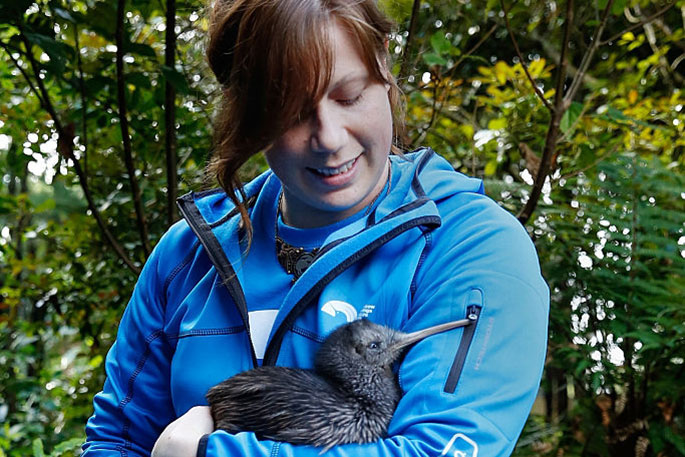
Rainbow Springs have celebrated kiwi conservation month in the best way they know how – by saving kiwi.
The nature park is home to Kiwi Encounter, which has grown to become the largest and most successful kiwi hatching facility in the world.
To coincide with Kiwi Conservation Month, which recognises and celebrates nationwide conservation efforts of kiwi, and Conservation Week last week, the facility hosted a conference which aims to share their knowledge of kiwi hatchery.
'October is Save Kiwi Month, so it's a pretty special month for us,” says Emma Bean, tumu kaitiaki kiwi (kiwi husbandry manager) at Rainbow Springs.
'This is the 10th Candling Course we have hosted here at Rainbow Springs. This year we've hosted about 100 people nationwide on the candling course and everyone who has attended the workshops has loved them, people generally go away buzzing,” she says.
'They are able to go away understanding what is going on in an egg. It's a good way to be a part of Save Kiwi Month,” she says.
'We are regarded as a ‘centre of excellence' having helped develop the protocols for successful kiwi hatching nationwide, so if anything goes wrong people tend to give us a call.
'The workshop teaches field workers, whether they work for the Department of Conservation, in community projects, or at other captive facilities, how to handle eggs and how to safely transport them out of the field for the kiwi recovery programme known as Operation Nest Egg. The two-day workshop also discusses how to manage any hatching complications that occasionally happen.
'Operation Nest Egg involves incubating the kiwi egg, hatching them and rearing them to a stoat-proof weight,” says Emma.
'Once they are a kilogram in weight they are then big enough to defend themselves against their main predator which is the stoat.”
'Instead of having a five per cent survival chance, they then have a 65 per cent chance. It's not 100 per cent because you still have ferrets, cats and dogs and you'd have to breed moa-sized kiwi for them to be able to defend themselves against those predators.
'It's a fantastic programme and we have hatched 1700 eggs already since we started it in 1999, with the majority hatched over the last 10 years.”
She says the workshops help to ensure conservation resources are spent effectively and efficiently.
'We've taught field workers, who actually go out into the wild, how to identify whether they have a viable egg or not so that they can save very precious conservation resources.
'If the eggs aren't good, we want to ensure they don't drive six hours to get to us.”
She says the workshops are a great way to promote the conservation work Kiwi Encounter does.
'It's been a busy year for us - one day we had six chicks hatch, but this workshop is a good time to show people what we do because so much is happening.
'A couple days out of ‘business-as-usual' means we can share our knowledge that we have built up over years.”
Kiwi Encounter is also open to public.
'Visitors can also see the whole process but everything we do is behind glass – people can see us in the incubation and hatch room or in the brooder room feeding chicks.
'We also have the nocturnal house so that people can see kiwi walking around in their natural environment during the day and we also have a night aviary, so when it's moonlit you can go into that aviary and see the kiwi out and about probing around as kiwi do in the wild, under the stars.
'Ordinarily people just see an egg as an item on an ingredient list, but this opens their eyes to the fact there is actually a chick inside there, a very precious chick which is an endangered species.
'People come around our captive facilities and are able to see what we do with the eggs, the look on people's faces when they see a kiwi egg moving around on the bench, because an embryo is big enough to make it wobble, that's just magical.”

0 comments
Leave a Comment
You must be logged in to make a comment.