


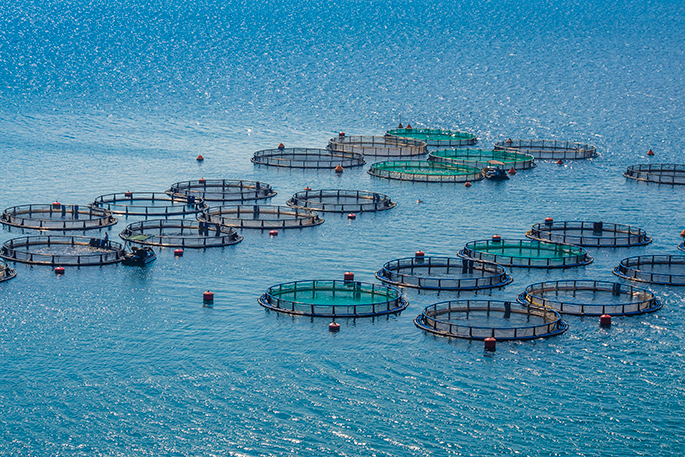
The Waikato Regional Council is calling for tenders to occupy up to 240 hectares of fish farming space in the Firth of Thames.
The space is in the Coromandel Marine Farming Zone which is about 10 kilometres west of Coromandel Town, and once operational, will be the first fish farming zone off the North Island.
Fish would be farmed in sea cages and the regional council believes the 300 hectares zone could eventually support the production of about 8000 tonnes of farmed fish – roughly comparable to the production of farmed salmon in the Marlborough Sounds.
Senior coastal policy advisor Graeme Silver says council began preparations for a tender last year after an expression of interest in taking up space.
'Shellfish aquaculture around the Coromandel and Firth of Thames, and related processing, generates just under $100 million of revenue a year and directly employs over 550 people, making us second only to the Marlborough Sounds in terms of production and employment.
'We believe that, over time, successful fish farming in the Firth of Thames zone could generate additional revenue of over $50 million.”
Several years ago there was strong interest in farming kingfish and hapuku in the region. The Coromandel zone was subsequently established in 2011 by a central government amendment to the Waikato Regional Coastal Plan
Then the global financial crisis struck and interest in fish farming waned. But recently there's been renewed interest in taking up space in the zone.
Space available in the zone will be released for development by the tender process which council is announcing, says Graeme.
'The successful bidder or bidders will be selected by considering their environmental management practices, the economic benefits to the community, and any monetary contribution to council and central government.”
Successful tenderers will then need to apply to the council for a resource consent.
Graeme says it is essential that environmental risks are adequately managed and mitigated through a comprehensive resource consent process.
Any application for a resource consent to farm fish would have to be accompanied by a site specific assessment of potential environmental effects and a monitoring plan, including a baseline survey.
'The resource consent process will determine whether that impact is sustainable. The major risks from fish farming are nutrients from feed and fish wastes stimulating the growth of algae, and farm operations interfering with marine wildlife.
'We believe these risks can be minimised through appropriate resource consent measures and a staged approach to development to ensure any emerging problems are dealt with.”
Graeme says from an environmental protection perspective, the relatively deep Coromandel Marine Farming Zone was a preferable area, compared to the Wilson Bay Marine Farming Zone in the Firth of Thames.
More information for potential tenderers is available at www.waikatoregion.govt.nz/aquaculture or by calling Senior coastal policy advisor Graeme Silver on 0800 800 401.
The 300ha Coromandel Marine Farming Zone is about 10 kilometres west of Coromandel Town.

0 comments
Leave a Comment
You must be logged in to make a comment.