


A completed study of New Zealand's state highway network shows a Bay of Plenty arterial road is one of seven nationally that carries a disproportionate amount of traffic.
Rated as a road of national strategic significance, the Tauranga Eastern Corridor – State Highway 2, which runs from Tauranga to Te Puke, is this route.

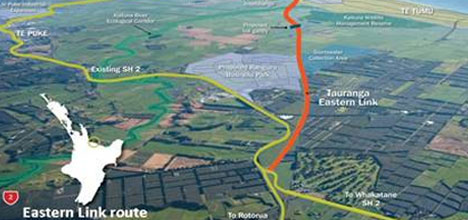
This is a plan of the Tauranga Eastern Link project which is an upgrade to the Tauranga Eastern Corridor highway stretch.
Transport Minister Steven Joyce says the other six highways in this category are: Puhoi to Wellsford on SH1, the Auckland Western Ring Road SH20/16/18, Auckland Victoria Park SH1, Waikato Expressway SH1, Wellington Northern Corridor SH1 and Christchurch motorway projects.
Steven says these highways are just 714km of road, making up one per cent of the state highway network, but carry 35 per cent of total vehicle kilometres on state highways, and 17 per cent of total kilometres travelled on the whole roading network.
Steven says classifying these roads as of national strategic importance will assist in forward planning.
'The seven roads of national significance are designed to tackle the biggest issues on these high volume highways for the benefit of the whole country,” says Steven.
The next step is to draft service and access levels for each category of the network – this will consider things like congestion levels, journey times, whether to expect driveways opening onto the highway, the need for passing opportunities and the type of safety improvements needed.
Public engagement on draft service levels will take place later this year as part of the NZ Transport Agency's development of the state highway network strategy.
'The state highway classification project won't directly impact funding or planning but it is another important tool to help us all strategically develop the network over time.”

2 comments
More inappropriate development for the post peak oil age
Posted on 23-06-2011 18:36 | By The Way Forward 2011
It is significant ( and concerning ) that with New Zealand being one of the 28 nations that fund the International Energy Agency, the world's most credible authority on energy related matters, our political leaders , who during the run up to the elections in 2008 were citing the International Energy Agency's assertion that 'peak oil wasn't expected to occur until around 2030' as their reason for not acting to prepare for it, are now choosing to ignore the latest announcement ( 25 May 2011 ) from the Chief Economist at the International Energy Agency which is that, based on their statistics, they now believe the world passed through 'peak oil in 2006 and that consequently governments around the world urgently need to reduce their vulnerability to ever increasingly expensive fossil-fuel prices. In accordance with what the Chief Economist of the International Energy Agency is saying , New Zealand needs to be refocusing spending away from fossil fuel dependent/vulnerable roading projects ( esp. those of 'National' significance) and into maintaining and developing our regional railways and infrastructures that enable and encourage other forms of sustainable & active modes of transport.
Does not add up
Posted on 24-06-2011 19:35 | By WOMBLE
For 10% of the $554 million cost (last projections issued by NZTA) the existing te Puke road could have been widened and perhaps a few passing lanes added and all would have been just fine. This would have to be one of the most expensive and of course pointless road schemes around.
Leave a Comment
You must be logged in to make a comment.