


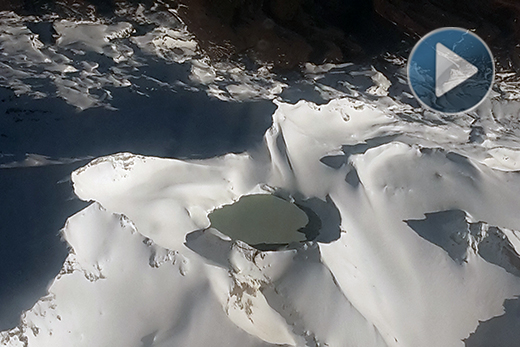
Recent sharp increases in temperature of Ruapehu's crater lake during the first week of September show the mountain is far from dormant.
The crater lake reached a new minimum temperature of 12 degrees Celsius on August 15, but since then its risen rapidly and on Wednesday GeoNet recorded a temperature of 17.6C.
Mount Ruapehu's crater lake reached a temperature 17.6 degrees Celsius on Wednesday, September 7. Photo: GeoNet. Watch the video below.
This high temperature has also been accompanied by volcanic tremor and an increase in the output of volcanic gas, says GeoNet volcano information specialist Brad Scott.
'For much of August the lake temperature ranged 13-14C, occasionally looking like it maybe going to turn and start heating,” says Brad.
'The temperature was starting to rise, very slowly, in late-August, but with quite a bit a lot of variability. However by September 2 a rising trend was clearly established.”
GeoNet obtains temperatures from the lake using a data logger with a temperature sensor in the lake and communications via a satellite link.
The lake's temperature typically ranges between about 15 and 40C, but it reached a record temperature of 46C on May 11, the highest GeoNet have observed since it reformed in 1999-2000.
'The Volcanic Alert Level was raised to Level 2 at that time, lowering to Level 1 in early July when the gas output and volcanic tremor levels declined,” he says.
'About two days after the lake temperature stared to rise on September 2, the level of volcanic tremor also started to rise and has remained present since September 4.
Brad says further sampling and visits to the crater lake are planned as the weather allows and is part of the standard GeoNet monitoring programme for Mount Ruapehu.
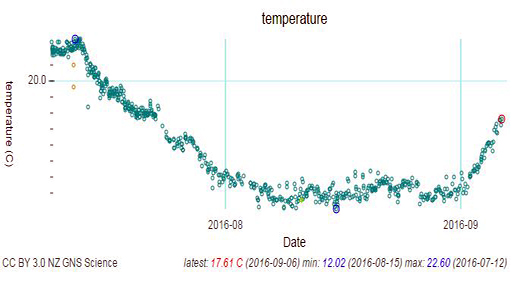
Temperatures of Mount Ruapehu's crater lake during August 2016. Image: GeoNet
Speaking to Fairfax, GeoNet Duty volcanologist Michael Rosenberg says the temperature change was similar to what they had seen at the end of 2014.
'It's certainly not a regular cycle but we typically see temperatures getting up to 40 degrees. The tremor has started again, and again we often see that at the same sort of time ... the processes are all linked together,” he says.
While GeoNet is not concerned about the tremors, Michael says what is happening now is just part of the volcano's normal behaviour.
'There are no exclusion zones in place at this time. Obviously it is an active volcano and it has the potential to erupt at very short notice. In a way it's reassuring to see that the normal heating and cooling behaviour is continuing,” says Michael.

0 comments
Leave a Comment
You must be logged in to make a comment.