


Every business in the country is going to face increased insurance costs as the effects of the February 22 Christchurch earthquake ripple through the economy.
Business excesses are almost certainly going to rise, says fire and general insurance adviser at Financial Independence, Ben Ruthe.
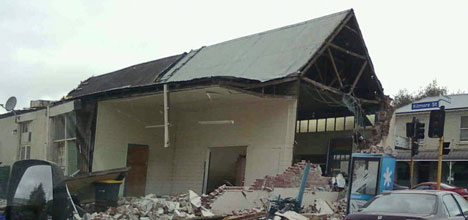
This antique store was destroyed in the February 22 earthquake, with such instances of ruined business the driver of increasing insurance excesses.
'For a lot of business owners the majority of insurers in the market have already increased excesses for natural disaster,” says Ben.
Previously business excess was about 2.5 per cent of the loss, now it's five per cent of the site value. Business owners in Christchurch would still have had the lower excess levels, says Ben.
'But now across the country, business owners will most likely be facing higher excess levels in the future.
'The implications from Christchurch are going to flow on as these things like excesses change.
'If there was to be another natural disaster then things like excess levels are going to impact on that next natural disaster more.”
The other aspect of insurance that is going to impact on all domestic insurance policies is re-insurance.
Re-insurance is insurance for insurance companies.
They farm out their financial risk of a mayor payout, usually from natural disasters, around the industry.
It is an operating cost and AMI is an example of what happens when the risk of being inadequately re-insured is called.
AMI is a mutual assurance company, owned by the policy holders as opposed to a limited liability company.
In a mutual company, any distributed surplus funds are paid entirely to policyholders. In a company with shareholders, a proportion of the surplus is paid to shareholders while the balance is held in reserve by the insurer.
'Being a mutual, I would have expected there would be quite a few AMI policy holders that weren't aware that they were actually the owners of AMI,” says Ben.
'I would say generally with shareholders you would have a little more scrutiny of the company's financial set up.
'They've certainly had some fairly competitive pricing in the market – I mean, at the end of the day you need an insurance company to be sustainable.
'If the company you are with hasn't been buying adequate re-insurance cover then it certainly saves that company significant costs of operating – but it exposes all the policy holders to a loss.
'In a short term, AMI was very profitable for every year that they were operating, but longer term if you don't have protections in place for these types of scenarios the company doesn't have any viability tong term.
'I think for AMI policy holders they are fortunate that the government is going to provide the financial backing so AMI doesn't collapse in the interim.”
Insurance companies have credit ratings and AMI's had dropped to A- before the Christchurch earthquake, says Ben.
'The issue that the government had to sort out was they had to pump in that backing to ensure that their credit rating didn't slip further,” says Ben.
'It was actually going to be slipping into the B or worse categories from all accounts.
'NZI and IAG for example, they have an AA- currently with Standard & Poors, they are the largest insurer in the country. Vero is the second largest in terms of domestic policy, they have an A+.
Because the government stepped in and is helping AMI out it doesn't look like their policy holders are going to be exposed, says Ben, but there will be ongoing implications.
AMI from now on will have to ensure that re-insurance is in place.
'The difficulty is that they are going to have is that the re-insurers globally are hesitant to offer cover to Asia Pacific because of the Japan and New Zealand earthquakes,” says Ben.
'So when securing additional cover, some insurers already adequately insured are going to feel pressure on costs in renewing those policies.
'The companies that didn't have adequate cover in the first place not only have to renew what they had, but also purchase additional cover and that's going to prove to be the challenge for them. The premium is going to be significantly higher this time.
For example, QBE reinsures for a three year period and they did that last year. Typically they do renew annually though. I understand AMI's comes up in June.
'This is just one of the issues. With a lot of the domestic insurance cover, they have alternative accommodation costs cover so that you can rent a house and carry on living if your house is damaged. There are issues with a lot of insurers only having six months for alternative accommodation costs.”
It has now been six months since the September quake. Christchurch families who have continued paying their mortgage on a house that cannot live in, are now facing having to pay rent as well.
Under insurance is another issue for earthquake survivors. Making sure the floor area of the insured property includes the garage – which is quite often not included.
'It's raised the importance of people checking their policies and getting advice,” says Ben.

3 comments
Nooo You Dont Say......
Posted on 11-04-2011 16:56 | By Tony
Dont forget to add in extra $$$s for the cost of petrol so you can drive out to inpect . Of course cost will go up , But isnt it funny how there seems to be little talk of the Billons from EQC used to off set costs anymore Maybe it would be better if everyone joined AMI Would that help with costs?
Elephants Memory
Posted on 12-04-2011 08:29 | By bigted
5 years ago, Quote - "The Earthquake and War Damage Commission has sufficient funds to cover any eventuality" Once again, the buck stops, but not in our pocket . . .
Blame EQC??
Posted on 12-04-2011 14:24 | By Matt
This is not all EQC's "fault" Ted and Tony. Has EQC run out of money? When? Ben has penned a good article here about insurance for business and home owners and it's worth remembering the following: 1. EQC does not cover commercial risks 2. EQC covers only the first $100,000 plus GST of domestic building claims, and excludes things like drives, fences and alternative accommodation. 3. EQC's funds are not available for use by insurers. The rest of the cover for EQ claims comes from insurers, that have to use their funds/investments, and/or make a claim themselves against their insurers (re-insurers). The point of insurance is to share the risk of financial loss amongst a pool of people and as a result of an increased risk and cost of obtaining cover we all pay. We could ensure EQC has more money for the next big one by paying more than we do at present in our domestic policies but we'd be against that too. IF the likes of AMI offered a sustainable product then that may have helped. As it is the Govt (ie you and me) will help AMI. Smile :)
Leave a Comment
You must be logged in to make a comment.