


While most people are lamenting the loss of the long evenings with the changeover from daylight savings time, astrophotographers are looking forward to the longer, cooler, nights.
Cynthia Qiu is a recent convert to astrophotography and says the cooler night temperatures allow better visibility.
Cynthia's photos taken at Redwood Valley farm Te Puke.
'We can view the milky way overhead with our naked eyes, given that the nights are so long,” says Cynthia.
'If we find a location with little or no light pollution, with some basic photographic equipment, one can easily capture the magical view of the band of light.”
An essential for astrophotography is planning, because there are a few basic steps to taking a clear picture of the Milky Way overhead, says Cynthia.
Get out of town away from the light pollution. McLaren Falls Park or remote farms and beaches are good options. And pick a night when there is no moon if possible or when the moon is new or waning. Google 'moon calendar” and pick days near new moon so the stars are shining.
The camera can be any digital camera with ISO 3200 or over, and allows long exposure for 15 seconds or more, says Cynthia. A good quality tripod is necessary to hold the camera in place during long exposures and a remote shutter release cable will be a bonus.
A lens with 35mm or shorter focal length is ideal in order to capture a wider angle view, but a standard lens will work as well especially for panoramic post processing.
"Use a fast lens, ideally f/2.8 or wider, and during shooting set it to the widest aperture, the smallest f number, then adjust ISO, aperture and shutter speed to get best results.
'During the night a light source is also a must to navigate the settings on the camera,” says Cynthia.
Set camera to Manual mode. Depending on size of the sensor, ISO 3200 or 6400 usually works well. 'For exposure, a general rule of thumb is the 500 Rule: 500 divided by the focal length of your lens will give you the longest exposure before stars start to have trails.
'For example, if you are using a 35mm lens, 14 seconds will get you started with a proper exposure.”
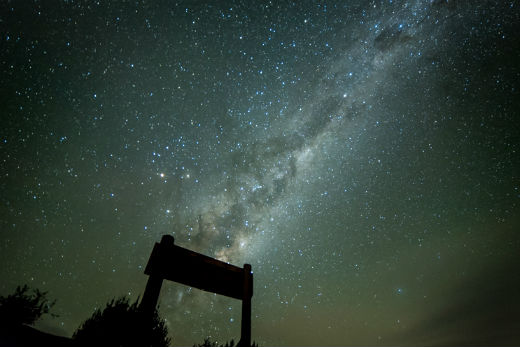
Turn off VR feature when mounted on a tripod, use a self-timer or remote shutter release, take off the camera strap, hang a heavy bag or stones on the tripod.
Focusing at stars can be challenging at night and the easiest way is to focus at infinity. The harder but more accurate way is to use live view, pick the brightest star on the screen, and zoom in to focus.
'Thanks to all the wonderful apps we do not have to study astronomy to find the galactic plane of the Milky Way, in which majority of the galaxy's mass lies,” says Cynthia.
'My favourite tool is the open sourced www.stellarium.org. It's only for desktop but you can learn ahead of time when the galactic plane climbs up the horizon from any location, so in the field you can focus on composition and photographing.”
The brightest part of the galactic plane is near Sagittarius, Ophiuchus and Scorpio. This time of the year these three constellations ascend after midnight but stay there for the most of the night.
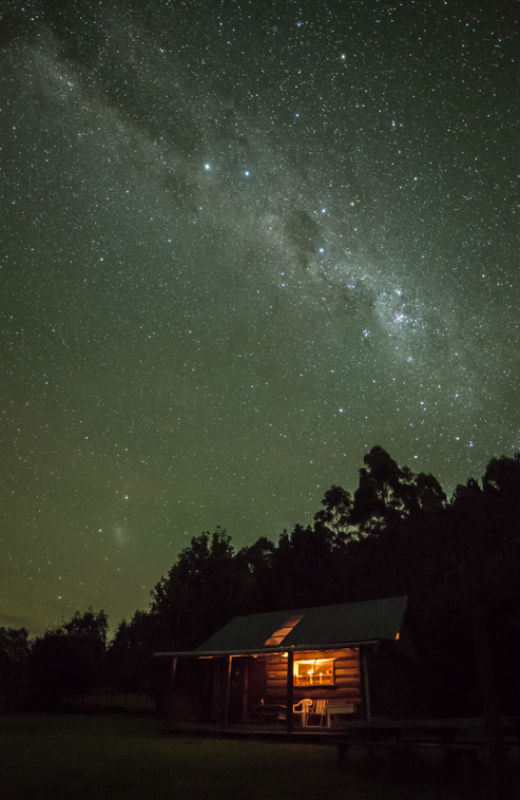
'There is nothing like looking at the Milky Way, so clear and almost close enough to touch,” says Cynthia.
'This is an experience that inspires all ages and we are very fortunate to be down under to see the southern sky.
'Another special thing to look for is the Magellanic Clouds. They are two cloud-like patches of neighbouring galaxies known as the Large Magellanic Cloud and Small Magellanic Cloud. They are easy to spot and can only be seen from the southern hemisphere.
"The upcoming event for astrophotographers is the Eta Aquarids meteor shower which peaks around 5am on 6th of May,” says Cynthia.
'The Eta Aquarids is one of two meteor showers created by debris from Halley's Comet. The Earth passes for a second time through Halley's path around the Sun in October, creating the Orionid meteor shower which peaks about October 20.
'Last time this annual meteor shower took place near a new moon was in 2005 and so this year it's a great opportunity to observe this event. Constellation Aquaris will climb high enough in the southern hemisphere to give us double the amount of the visible meteors,” says Cynthia.
'It's magical up there and it's addictive.”
Some great sites to visit:
Royal Astronomical Society of New Zealand

0 comments
Leave a Comment
You must be logged in to make a comment.