


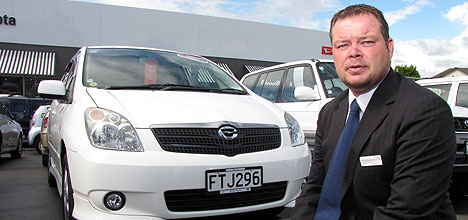
A production halt in Japan following the March 11 tsunami is expected to increase the price of cars in Tauranga as the next rounds of imports arrive in New Zealand.
The disaster has caused factories to stop producing new cars, leading to greater pressure on the used car market – particularly in Japan, as people there are now buying used.
Tauranga Pacific Toyota sales manager Chris Churchwood says the impact of the March 11 Japan disasters on the New Zealand car market is about to be realised.
This has a direct influence on the numbers of imports available to New Zealand of both new and used cars.
Tauranga Pacific Toyota sales manager Chris Churchward says supply is going to be short.
'Within the next two to three months there will be shortages of certain models and makes,” says Chris.
He says the discounts and negotiations on car prices are going to change.
'It will make prices of new cars go up.”
He says the problem is going to be a regular supply of parts to the industry.
'Manufacturers will try to protect their supply – it's interesting times.”
Car Connexxion manager Jonathan Allen says it will take several months for the impact to filter down to the used car market.
Car Connexxion in Tauranga imports between 40 and 50 second-hand cars from Japan every month.
Jonathan says the number of vehicles going through the auction in Japan is the same, but the selection is poor.
'They are filling it up with stuff that wouldn't normally be there,” says Jonathan.
'The selection of vehicles at auction in Japan has dropped about 20 to 30 per cent.
'The effect hasn't really filtered down to the used-car market yet.
'It will take a few months, after a shortage of new cars become available.”
Japanese imports have been their core business for the last eight years, says Jonathan.
He says the tsunami hasn't helped, but the new admission regulations for used cars, which are due to come into force, is going to affect a lot of businesses in Tauranga also.
'We'd only be able to import 10 of the cars we are currently from Japan.
'It creates problems for not only us, but a lot of other businesses which rely on us for business.
'From next year we will only be able to import cars with a three-digit admission code on their chassis number.
'A small number of 2004 models, but most from 2005 have it, but some cars, for example our most popular car, Nissan Primera, the 2006 model, doesn't even have it.
'We are a bit restricted with what we can do to be honest. We haven't managed to find an answer yet.
'All the dealers in town are in the same boat.”
The New Zealand market compared to the Japanese is minuscule, says Jonathan.
Before the Japanese imports in 1988 there was a huge shortage of second-hand vehicles.
'I think it's going to go back to that. It's a huge concern for us.”
Jonathan says people will have to get their head around paying the same for a car that's done 100,000km to what they are paying currently for one that's done only 50,000km.
'The most frightening thing for the industry is how many job losses there will be because of the reduction in cars being imported.”

7 comments
Typical Spin Doctoring
Posted on 04-04-2011 12:03 | By Tony
Ok we just wont change our cars for another 3 or 4 months ....Would that make you happy ?
Poor Diddums...
Posted on 04-04-2011 12:40 | By morepork
I'm not a spiteful or gleeful person, I don't like seeing anybody have a hard time, so why do I feel no sympathy at all for these car dealers? I see this as a cynical attempt to condition us into paying higher prices for cars. So what "added value" are dealers going to include, to encourage us to change our cars at a higher price than would previously have been the case? How much will they "absorb"? (yeah, right...) As buyer resistance stiffens, the marketplace changes. I'll happily keep my current car for a few more years if the cost of replacing it becomes non-viable. Has production in Korea, or the USA, or Australia, or Europe been affected? "Jonathan says people will have to get their head around paying the same for a car that's done 100,000km to what they are paying currently for one that's done only 50,000km." I don't think so. Jonathan needs to get HIS head around the concept of a marketplace and consumer choices.
Some narrow views here
Posted on 04-04-2011 13:50 | By The author of this comment has been removed.
Yes in the short-term new cars from Japan will be marginally more expensive. If you dont need a new car in the next 6 months then you have nothing to worry about. The second issue is secondhand cars from Japan.
Every couple of years the government shifts the goalposts, forcing us needlessly into newer and newer cars. This is where the real price increase occurs, you COULD buy a low mileage mid or late 90s car in mint cond from Japan, except that you cant bring in anything older than 2000. And from next year nothing older than 2004! (The average kiwi drives a car 13 years old, mine is 23yrs)
This means all second hand vehicles will cost more to buy, the value is reduced needlessly (in the supposed name of safety), and those that might've bought a modern safe car, will be forced to buy an older lemon instead. These changes come at a time of increased demand in this sector and lower than average supply, not to mention the economy... The effect of the Tsunami in Japan is of little concern compared with this stupid legislation.
Only Japan Made
Posted on 04-04-2011 14:29 | By cinik
Toyota has manufacturing or assembly plants in Japan, Australia, India, Sri Lanka, Canada, Indonesia, Poland, South Africa, Turkey, Colombia, the United Kingdom, the United States, France, Brazil, Portugal, and more recently, Argentina, Czech Republic, Mexico, Malaysia, Thailand, Pakistan, Egypt, China, Vietnam, Venezuela, the Philippines, and Russia. I hope this is not just an excuse to increase prices.
Hyundai must be happy
Posted on 04-04-2011 14:31 | By cinik
I wonder if their prices are going up?
Boycott and buy Korean instead
Posted on 04-04-2011 14:45 | By al pillocksworth
It wasn't long ago that the Japanese manufacturers were oversupplying the market. Has the world economy changed that much that cars are now so sought after? Then there's the recall issues faced by Toyota and some other companies. I've a feeling it's still a buyers market unless people get sucked into the belief that the manufacturer's doing them a favor.
lo
Posted on 04-04-2011 22:03 | By Capt_Kaveman
i have a car that is 10yrs old and it goes ok etc then i have a car that is 24yrs old and i still rather drive that
Leave a Comment
You must be logged in to make a comment.