


Environment Minister Dr Nick Smith has hit back at the critics during his first reading of the Kermadec Ocean Sanctuary Bill this week.
Act's labelling the Bill as ‘greenwashing' because fish will swim through and still be caught outside the zone.
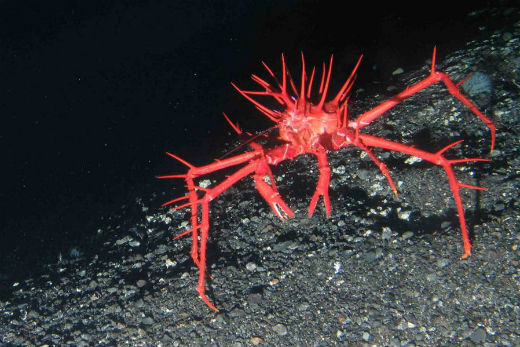
A Kermadec stone crab on the slopes of the underwater volcano Rumble II. Photo: NIWA. Photo: NIWA
'On this basis, you would not create any protected areas,” says Nick. 'I challenge Act to visit long established marine reserves like Leigh, observe the stunning marine life, the size of the crayfish, and snapper because they are living proof that MPAs work.”
The Greens says it is contradictory of the government to promote a sanctuary while supporting development of fishing, aquaculture, oil, gas and mineral resources at sea.
'This misunderstands our Bluegreen approach of providing for areas of economic development and protection both at sea as on land,” says Nick. 'It is about balance and ensuring New Zealand is both economically and environmentally successful.”
New Zealand First's criticism that New Zealand doesn't have the capacity to ensure the zone's protections are complied with, underestimates modern satellite technology, the capacity of RNZN and the increased cooperation in the Pacific on maritime surveillance, says Nick.
The Kermadec Ocean Sanctuary at 620,000 square kilometres, is twice the land area of New Zealand or about the size of France. It amounts to 15 per cent of New Zealand's EEZ and has New Zealand as one of the few countries overachieving the global 10 per cent target for biodiversity protection.
The area of the proposed Kermadec sanctuary is 35 times the area of the total of all New Zealand's existing marine reserves and fifty times the size of the country's largest National Park in Fiordland.
Outstanding geological and biological diversity also makes it significant, says Nick.
The sanctuary contains the longest arc of underwater volcanoes anywhere in the world and it descends to a depth of over 10 kilometres, deeper than Mount Everest is tall.
'The depths of the ocean combined with the underwater volcanic activity makes for an extreme environment of pressure, temperature and acidity where unique forms of life exist that are almost as fascinating as studying life on another planet,” says Nick.
'The sanctuary's marine life includes over 6 million seabirds of 39 different species, 35 different species of whales and dolphins, three species of sea turtle - all of which are endangered, and over 150 species of fish.”
The Kermadecs also have a rich history. It was a crucial stopover point for the migratory waka that made the long and treacherous journey between the Pacific and New Zealand. It is the only part of New Zealand that got caught up in the horrific global slave trade of the 19th century with the atrocious deaths of 160 Pacific slaves destined for South America on Raoul Island in 1863.
The recognition of the area for its natural values gained momentum in the 1930s with a nature reserve gazetted in 1939 and the territorial sea protected in 1990.
'This is a bill about securing a better future for our oceans and I commend it to the House,” says Nick.
The Bill is to be considered by the Local Government and Environment Select Committee and be reported back to the House by August 2.

1 comment
Sanctory
Posted on 19-03-2016 14:14 | By Crash test dummies
Is a great idea, better than not a simple no brainer for sure.
Leave a Comment
You must be logged in to make a comment.