


Nick Smith's Kermadec Sanctuary project is undermined by the Prime Minister's statement that the Kermadec Ocean Sanctuary Bill won't stop people taking fish, says ACT Leader David Seymour.
Last week John Key acknowledged that what fishers would catch in the sanctuary region would be migrating species like tuna, which they can catch somewhere else, says ACT party leader David Seymour.
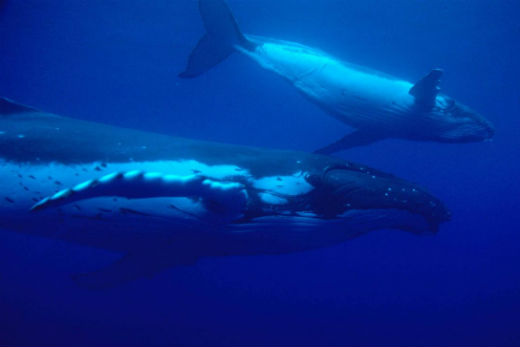
Humpback whale and calf. Photo: Malcolm Francis, NIWA.
'The Prime Minister has acknowledged what was explained in the Cabinet paper for this legislation – fish can swim. Operators can still take the same amount of fish, they just have to wait for the stocks to migrate outside of the sanctuary area,” says David.
'Commercial fishers, recreational fishers, and conservationists alike all seek abundance in our oceans. But the end result of this bill is a huge logistical challenge for fishers, with no new limits on the actual amount of fish taken to justify the hassle.”
The Government ought to be supporting both fish stocks and fishers, says David, and the green-washing manages to neglect both.
The Kermadec Ocean Sanctuary Bill was introduced to Parliament by Environment Minister Nick Smith last week.
The Bill establishes one of the world's largest and most significant fully protected ocean areas in New Zealand's Exclusive Economic Zone.
The Bill prohibits all forms of fishing and mining in a 620,000 square kilometre area of the EEZ from Raoul Island in the north to L'Esperance Rock in the south.
'The Kermadec Ocean Sanctuary covers one of the most pristine and unique environments on Earth,” says Nick.
It includes the second deepest ocean trench at over 10 kilometres – deeper than Mt Everest is tall – and an arc of 30 underwater volcanoes – the largest anywhere on earth.
It is home to six million seabirds of 39 different species, over 150 species of fish, 35 species of whales and dolphins, three species of sea turtles – all endangered – and many other marine species like corals, shellfish and crabs unique to this area.
'The scale of this sanctuary – at twice the size of New Zealand and 50 times the size of our largest national park in Fiordland – makes this a significant environmental achievement.”
The Bill includes important details on how the new Kermadec Ocean Sanctuary will be managed. It proposes a new Conservation Board be established, which will be responsible for developing a conservation management strategy for the sanctuary, existing marine reserve and on-land nature reserves.
The two iwi, Ngati Kuri and Te Aupouri, will each have the opportunity to nominate a board member.
Activities permitted in the sanctuary include navigation of ships, overflight by aircraft, marine scientific research, and submarine cables for communication. Scientific research programmes requiring consents will be done through the Environmental Protection Authority, which is responsible for other areas of the EEZ.
The Bill is set down for first reading this month and is intended to be referred to the Local Government and Environment Select Committee for public submissions, with the ambition of being passed so that the sanctuary can come into effect on November 1.

0 comments
Leave a Comment
You must be logged in to make a comment.