


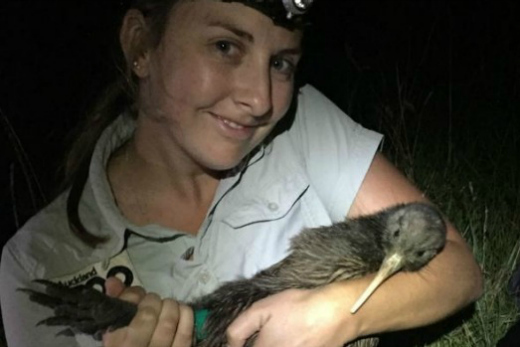
Five ‘teenage' Coromandel brown kiwi raised on Rotoroa Island in the Hauraki Gulf were returned to their home in Te Mata on the peninsula on Saturday.
They were among the first chicks to be released into 83ha predator-free haven on Rotoroa during the 2014/15 breeding season under a new partnership between Auckland Zoo, Rotoroa Island Trust and Thames Coast Kiwi Care.
Five Coromandel brown kiwi have been released back into the wild in te Mata on the Coromandel on Saturday. Pictured: Auckland Zoo birds keeper Natalie Clark. Photo: Auckland Zoo/Fairfax NZ
Now aged between five months and a year, the one male and four female kiwi were collected as eggs from a 2500ha block in Te Mata which is intensively trapped by TCKC volunteers.
They were then incubated, hatched, and reared by Zoo staff before being released onto Rotoroa at around three weeks old.
Thames Coast Kiwi Care chair Richard Moyle says their release on Saturday was an exciting day for his team of volunteers.
'The return of kiwi to Te Mata is truly a milestone for our small volunteer organisation that is operating largely out of sight of public gaze,” says Richard.
'Future generations of New Zealanders can only be grateful for the generous and ongoing assistance of Auckland Zoo, Rotoroa Island Trust and the Department of Conservation in making our colony of Coromandel brown kiwi a self-sustaining population.”
Some of the kiwi being released will be fitted with transmitters and tracked over the coming six weeks to monitor their dispersal.
To date, 13 more kiwi chicks have released onto Rotoroa as part of the 2015-16 breeding season, while a 14th chick has just hatched at Auckland Zoo this week. A second kiwi muster will take place next summer to return more kiwi to the Coromandel.
Auckland Zoo Birds keeper Natalie Clark, who's been involved in the full life-cycle of the birds, says the released kiwi tripled in size during the five months they spent on Rotoroa.
'It now feels great to be bringing these birds back to Te Mata where the TCKC volunteers are putting so much work into trapping,” she says.
'As long as holiday makers and Coromandel locals keep their dogs on a lead when they're in kiwi country, we have a chance to save these special birds and see them thrive.”
Rotoroa Island chair Barrie Brown says seeing Rotoroa provide a haven for chicks and watch them returned to the wild as young adult birds is hugely rewarding.
'It's a testament to the hard work of a great many people, from community conservation groups, to Auckland Zoo, the Department of Conservation and our own island staff. It's wonderful to know that Rotoroa has safely reared and released a new generation of kiwi.”
The Coromandel Island brown kiwi is the rarest of the four populations of brown kiwi, and this new partnership aims to help boost their numbers.

0 comments
Leave a Comment
You must be logged in to make a comment.