


Thirty little spotted kiwis will be packing their bags and relocating to new homes around the North Island next week.
Ten female kiwi from Kapiti Island will be flown to Red Mercury Island in the Coromandel, while 10 females from Red Mercury and 10 males from Kapiti will also be moved to Cape Sanctuary in Hawke's Bay.
The little spotted kiwi. Next week 30 kiwi from Kapiti Island and Red Mercury Island will be relocated around the North Island. Photo: Sean Gillespie
The unprecedented and largest-ever translocation effort is part of the Department of Conservation's attempts to increase the genetic diversity of the birds' population.
Conservation Minister Maggie Barry says introducing Kapiti birds to Red Mercury will strengthen genetic stock and ensure the population remains viable for long-term growth.
While mixing the Red Mercury and Kapiti bloodlines at Cape Sanctuary will give the new colony a robust genetic base.
'All the 1700 little spotted kiwi alive today trace their descent to just five birds taken to Kapiti Island from Ngai Tahu's rohe in Jackson Bay, South Westland, more than 100 years ago.”
'The population on Red Mercury Island went through a further bottleneck, as it descends from just 12 birds first released there in 1983.”
Lack of genetic diversity causes issues such as low breeding success rates.
All the birds being moved will be caught at night by hand, or during the day with assistance from trained kiwi detection dogs.
'They will then be transferred in specially-built boxes by helicopter from Kapiti to the mainland, flown by Air New Zealand from Paraparaumu to Auckland and helicoptered to and from Red Mercury Island. The Red Mercury birds will be flown by Air NZ from Auckland to Napier.
Maggie says DOC has worked with iwi from five different rohe [areas], the Kiwis for Kiwi Trust, Cape Sanctuary and Air New Zealand to make this move possible.
'Kiwis for Kiwi have made a $25,000 contribution towards the cost, while Air New Zealand has generously allowed DOC to use its flights to transport the kiwi to their new homes.
'In Budget 2015 we committed $11.2 million to save the kiwi from extinction in the wild. This translocation is a superb example of DOC working in partnership with iwi, community groups and business to save our national bird and ensure it survives for our grandchildren to experience.”
The little spotted kiwi is the smallest kiwi species and was once abundant across both islands, but the North Island population was extinct by the late 1800s due to predation by introduced pests.
The South Island population survived on the mainland until the 1980s but the species is now found only on offshore islands and in fenced sanctuaries such as Zealandia in Wellington.
The largest population is present on Kapiti Island, home to around 1200 birds.
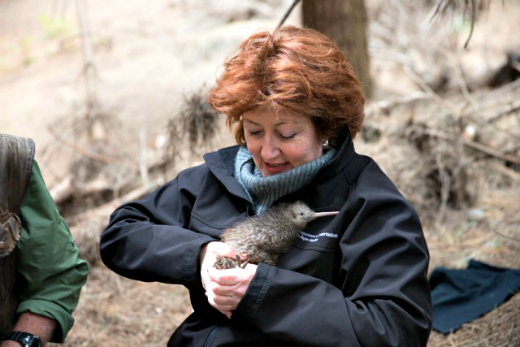
Conservation Minister Maggie Barry. Photo: Maggie Barry

0 comments
Leave a Comment
You must be logged in to make a comment.