


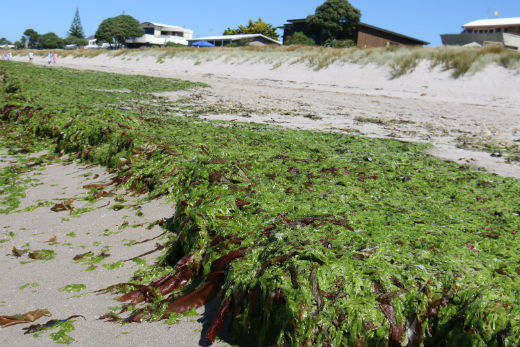
Around 430 tonnes of sea lettuce has been removed by Bay of Plenty Regional Council contractors from Tauranga's beaches so far this season, and that figure is just the beginning of what is expected to be a bumper ‘crop'.
Long-term trends show the largest blooms coincide with El Nino weather patterns, which are forecast this summer, and areas across the region will be effected, including Ongare Point, Kauri Point and Pahoia.
Authorities are expecting a summer of sea lettuce. Photo: File.
'In partnership with Tauranga City Council and Western Bay of Plenty District Council, we regularly monitor busy beaches and arrange sea lettuce clean ups as practical and necessary,” says Tauranga Harbour Projects Manager Bruce Gardner.
'We're also reducing all the land-derived nutrient inputs to the harbour that we can, through our work with land and business owners to improve run-off and storm water management.”
The growth of the naturally occurring algae is mainly influenced by coastal currents, nutrient levels, water temperature and water clarity, says Bruce.
In addition to cleaning up sea lettuce, regional council is also paying $210,000 a year to support sea lettuce research by the University of Waikato Coastal Chair of Science and local PhD students.
Bay of Plenty Regional Coastal Science Chair, Chris Battershill, says a Waikato University research team is building on a solid platform of monitoring data to better understand sea lettuce dynamics and management options.
'We're also collaborating with other New Zealand and international researchers,” says Chris, 'including a group from Tauranga's sister city Yantai, who happen to be experts in marine nuisance algae.
'The Yantai group was directed by the Chinese government to work on the sea lettuce problem that caused issues in the 2008 Olympic Games sailing event in Qingdao.
'They've found uses for sea lettuce so that they're now harvesting it. A key use in addition to biofuel is fertilizer. They'll be helping us with research, starting next year, to see what else can be done with Tauranga Harbour's sea lettuce.”
A trio of major PhD projects examining aspects of local sea lettuce ecology have been completed this year and are currently being reviewed. Another further PhD project has just started, confirms Chris.
The PhD findings are complemented by other coastal research work. Manaaki Taha Moana has completed an assessment of nutrient and species interactions in the intertidal zone throughout the harbour and is now exploring the subtidal channels.
'Following the MV Rena grounding, near shore coastal habitats were also mapped,” says Chris, 'showing shallow emergent reefs with sea lettuce on them.
'The near-shore reefs are a very likely additional source of sea lettuce. We'll be looking further at the ecology of those systems next year.
'We're also starting new work to map sea grass health using drones. That will confirm the nutrient sources and sinks in the harbour as well as exploring the interactions between sea grass health and sea lettuce abundance.”
In combining the new projects, the university will be in a position to better understand how to manage sea lettuce blooms or make better use of the blooms when they occur.
Sea lettuce concerns should be reported to Bay of Plenty Regional Council's Pollution Hotline on: 0800 884 883 or Tauranga City Council on: 07 577 7000.

0 comments
Leave a Comment
You must be logged in to make a comment.