


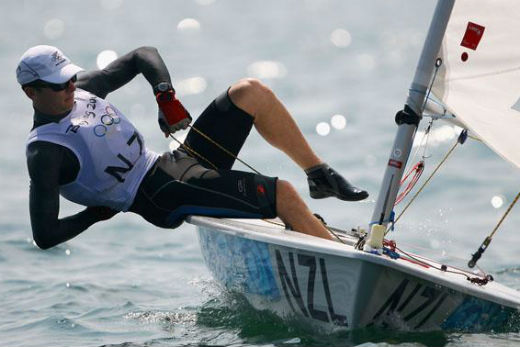
Tauranga Yacht and Power Boat Club's Andrew Murdoch is taking on the world's best dinghy class sailors in the 2015 Fin n Gold Cup being raced at Takapuna Beach next week.
Andrew and a handful of other New Zealand sailors are taking on more than 90 sailors from 30 countries off Takapuna in the open Pre-Gold Cup event from 17th – 19th November 17 to 19, and then the following week the Takapuna Boating Club and the New Zealand Finn Association will be hosting the 2015 Finn Gold Cup from November 21 to 29.
Tauranga Finn sailor Andrew Murdoch. Picture: Sailing NZ.
The gold Cup is the second qualifying regatta for the Rio Olympics in 2016, and competition is expected to be fierce for the available places.
It has been seven years since New Zealand last hosted an Olympic class world championship regatta in sailing and 35 years since the Finn class came to New Zealand for their world champs.
The Finn Gold Cup is the highlight of the Finn sailing calendar and is widely regarded as one of the foremost sailing events in the World. To win it is an exceptional achievement, twice is remarkable, and three times is outstanding.
Until recently this has only been done on four occasions: Willy Kuhweide of Germany in 1963/1966/1967, Lasse Hjortnäs from Denmark in 1982/1984/1985, Fredrik Lööf from Sweden in 1994/1997/1999 and Jörg Bruder of Brazil who won it three times consecutively in 1970/1971/1972 and remained unbeaten as he was tragically killed in an air crash in 1973 on route to defend his title.
Since then Ben Ainslie from Great Britain has dwarfed all other accomplishments to win the trophy six times – 2002, 2003, 2004, 2005, 2008 and 2012.
The Olympic heavy sailing dinghy was designed by Swedish canoe designer Rickard Sarby in 1949, as his entry in a design competition to select a new monotype dinghy for the 1952 Olympics Games in Helsinki.
In 2016, the Finn will have sailed for the 17th time at an Olympic Games and is the longest serving dinghy in the Olympic Regatta.
The Finn is one of the survivors of the sailing world. It has survived numerous re-selections of Olympic classes and 60 years of careful technical development, from the wooden hulls, wooden masts and cotton sails of the 1950s to the GRP hulls, to the carbon masts and kevlar sails of the 1990s.
It has sustained criticism over the years for being hard to sail and expensive to campaign but it has always won through. And in spite of all this it has strengthened its position as the world's premier dinghy for tactical as well as technical singlehanded sailing.

0 comments
Leave a Comment
You must be logged in to make a comment.