


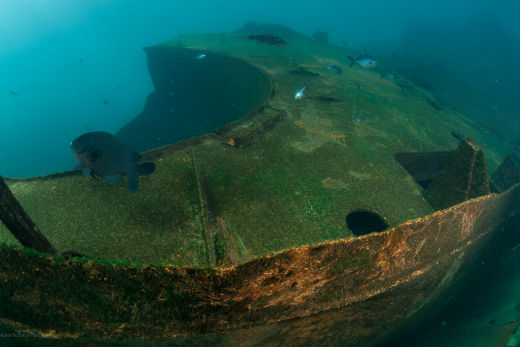
One of the world's top divers has endorsed recreational diving on the wreck of the Rena, saying spending too much effort making the wreck ‘safe' is a waste of time and money.
Dr Simon Mitchell is a specialist from the Australian and New Zealand College of Anaesthetists, and received the Behnke Award from the Undersea and Hyperbaric Medical Society in 2010 – their highest award for scientific contributions to the field.
Dr Simon Mitchel - the Rolex Diver of the Year - has endorsed recreational diving on the wreck of the Rena. Photo: File.
Having dived for 42 years, accumulating more than 6000 dives Simon has explored shipwrecks all over the world, and was named the Rolex Diver of the Year earlier this year in the USA.
As an expert witness for the Rena's owners and insurers, he's told the hearings panel that in spite of all the hypothetical hazards identified on the wreck site, there's very little evidence of accidents on comparable New Zealand wrecks
He also stated that removing all wreckage above 30m (the normal recreational dive limit) may have the unintended effect of decreasing safety by forcing divers to go deeper in as they seek a 'wreck experience”.
'If, as I contend, the related risk of adverse outcomes is very low, a focus on such hazard inventories may result in excessive mitigation initiatives of high cost and unlikely benefit,” says Simon.
Of the five New Zealand wrecks that are regularly dived – the Mikhail Lermontov, Waikato, Canterbury, Wellington and Tui – there has only been one confirmed entrapment death, a second probable entrapment death, and one death associated with a flawed descent procedure in 75 years.
'There have been no significant traumatic injuries that I am aware of,” says Simon.
'In responding to the articulation of hypothetical hazards associated with leaving wreckage in the shallow debris field at the Rena site, I would ask ‘Where is the evidence that these hazards are significant?”
There is no definitive record of non-fatal incidents on New Zealand wreck dives, and there have been very few related referrals received at the Slark Hyperbaric Unit.
'The overwhelming majority of any decompression–related incidents must be minor with no long term consequences to the diver,” says Simon.
'I cannot exclude the possibility that there are minor traumatic injuries on these wrecks that we are unaware of, but through discussions with prominent operators leading trips to these wrecks, I am virtually certain there have been no major traumatic events during diving on the five wrecks.”

2 comments
Safe?
Posted on 18-09-2015 20:36 | By Raewyn
If it not safe for Divers to clear the debris how can it be safe for recreational divers?
Rena wreck diving
Posted on 18-09-2015 21:07 | By Theodorus
To leave the wreck as and where it is may benefit wreck diving enthusiasts but what will happen if rust holes form over time and the kontenses fall and leak out and poison the sea and shore an fish etc. and when fishing I would not drop my anker arround there By Theodore.
Leave a Comment
You must be logged in to make a comment.