


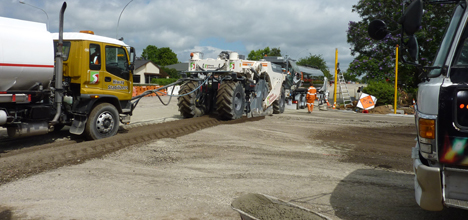
It's called ‘foam', but that's engineering talk for a mix of gravel, bitumen, cement and water.
The 'foam train'.
It is being used as the main structural layer in the revamped 15th Avenue and Fraser Street intersection.
The ‘foam' stabilised main structural layer is the third of five layers that will make up the new roading pavement.
Contractors began laying the stabilised foam layer on Friday and expect to complete this phase over the weekend.
It is machinery intensive. Cement is spread over the base course. The ‘foam' stabilising ‘train', comprising a bitumen truck, the stabilising machine, and a water truck, passes over.
The stabilising ‘train' scoops 200mm of the pre-laid gravel and cement, mixing it with controlled amounts of bitumen and water – and re-laying it on the road surface.
The stabilising machine controls the process, pushing the bitumen truck and pulling the water truck behind it.
Computers assess and adjust the amount of water and bitumen required to form the optimum ‘foam' mix.
The ‘foam' stabilised layer is rolled and trimmed to height ready for the bitumen seal and asphalt layers.
Its faster process results in a stronger product than traditional methods with lower long term maintenance costs, says NZ Transport Agency regional communications advisor Philippa Ross James.
It also creates a weather-proof surface which can be driven on within a day, compared to up to three days using a traditional method.

0 comments
Leave a Comment
You must be logged in to make a comment.