


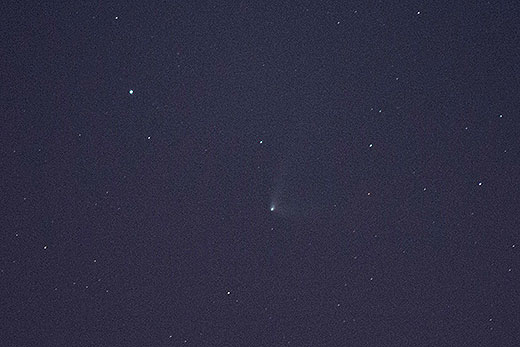
A comet discovered last year was snapped in Bay of Plenty skies overnight.
Comet C/2014 Q1 Pan-STAARS is now visible for few a days to the unaided eye, just after sunset.
Comet C/2014 Q1 Pan-STARRS, seen in this photo sporting two tails, was spotted in the night sky last night. Photo: Cameron Avery.
The comet rounded the sun on July 6 and apparently shed quite a bit of gas and dust.
At the moment, the comet is as close as it will ever get to the earth, which is another factor in its recent apparent brightness and the large angular extent of its tails.
The comet is sporting two very different tails. Pointing straight up is the ion tail, made of gas that sublimated away from ice in the comet and which was subsequently ionized by the Sun's ultraviolet light.
Due to its proximity to the sun, the comet and its tails may best be seen in the sunset din with binoculars or cameras using long-duration exposures.
Ionized gas is missing one or more electrons, giving the atoms or molecules a positive charge, Phil Plait explains in his blog about the comet on slate.com
'The sun's solar wind blowing past the comet carries its own magnetic field,” explains Phil, 'which sweeps up the ions and carries them away.
'The solar wind is typically blowing at several hundred kilometers per second, far faster than the comet, so the ion tail points directly away from the sun.”
In the meantime, as the ice holding the comet together turns to gas, it also loosens dust in the comet.
This leaves the solid nucleus, and gets hit by sunlight.
This gives the dust particles a little bit of energy, changing their orbits much more gently than the ions.

0 comments
Leave a Comment
You must be logged in to make a comment.