


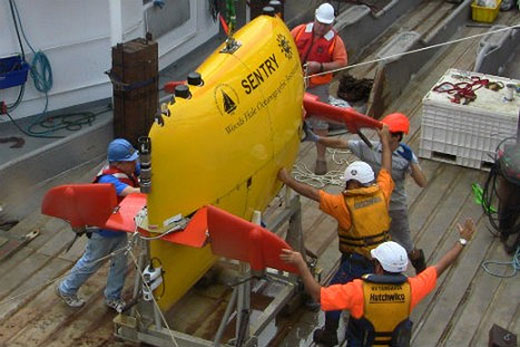
Six NIWA scientists are working with scientific colleagues from Japan in a science exchange programme focussing on seabed imagery.
The autonomous submersible Sentry collected terabytes of data at a time.
Led by marine biologist Dr Ashley Rowden, the scientists are working with scientific colleagues from Japan in the four-day workshop supported by the Royal Society of New Zealand, the Japan Society for the Promotion of Science (JSPS) and NIWA.
The workshop at the Global Oceanographic Data Center (GODAC) on Okinawa, one of Japan's southernmost group of islands, is focusing on advancing the analysis and management of seabed imagery gathered during the voyages aboard RV Yokosuka.
The voyages brought together scientists from NIWA, GNS and JAMSTEC, the Japan Agency for Marine-Earth Science and Technology, and created a bank of image data and video of unique seabed ecosystems in the first detailed biological investigations of the three study areas.
As well as Dr Rowden, Drs Malcolm Clark, Jennifer Beaumont, David Bowden, Daniel Leduc, Invertebrate collection manager Sadie Mills and Masters student James Wilson will attend the workshop that promotes the exchange of research ideas and experience.
That includes discussion of data gathered by JAMSTEC'S three-man submarine Shinkai 6500, one of the world's most advanced deep sea research submersibles which is capable of diving 6.5km below the ocean surface.
Investigations focused on documenting what seafloor animals live at the second deepest place in the ocean - the Horizon Deep in the Tonga Trench at 10,800 metres - to determine what limits life at extreme environments.
Research at the Louisville Seamount Chain was designed to understand what changes in seafloor life are brought about over time as seamounts become subducted at oceanic plate boundaries.
Submersible dives at the northern Kermadec seamounts collected images of life at hydrothermal vents, which can be contrasted with those already taken at vents further south and closer to New Zealand.
Collaboration with Japanese scientists, and the use of a deep-diving submersible, has provided New Zealand scientists the opportunity to undertake research that they would not otherwise have been able to achieve.
The workshop is among the first since the Prime Ministers of New Zealand and Japan agreed in 2013 to encourage stronger cooperation in scientific research in the Pacific.

1 comment
In disguise?
Posted on 19-07-2015 18:08 | By YOGI BEAR
This is a fishing expedition, they will be looking for whales and the like to take back to Japan all in the name of science.
Leave a Comment
You must be logged in to make a comment.