


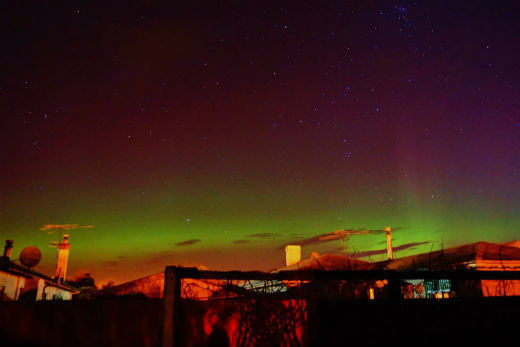
The sunspot causing this week's solar flares and rare sights of the Aurora Australis seen form the South Island is turning away from earth.
After the pummelling the planet's magnetosphere received earlier in the week, its last shot was a glancing blow that arrived Thursday morning (NZ time).
Ann Gutschlag posted this photo this week on the Facebook group Aurora Australis.
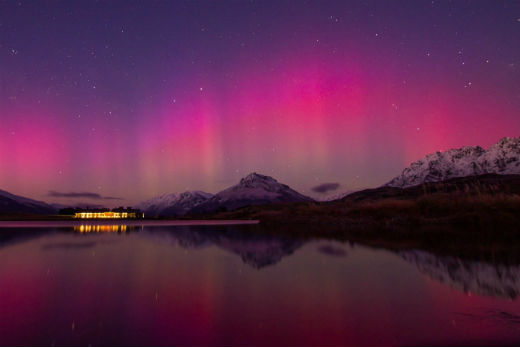
Richard Howell took this photo near Queenstown this week.
The action earlier in the week was enough to have Tauranga aurora enthusiast Terry Coles taking low-light cameras to the top of the Kaimai Range, but he saw nothing.
'There's a lot of photos from the South Island on the web,” says Terry. 'If it had gone up one more notch we would have seen it from here.”
It's possible to see an aurora from the top of the Kaimai Range, but difficult, says Terry.
'It's only 500 metres high I think. You're having to look across the central plateau of the North Island because of the curvature of the earth.
'The aurora is anything from one to two hundred kilometres above the surface of the earth. On a clear night you can see them from a 1000 kilometres away. So that would take us to the bottom of the South Island,” adds Terry.
'A big storm we would see it from the top of the Kaimai Range, on the horizon. If it gets to G5 I will be taking some gear up there again.
'Once we get one hit like that our geomagnetic field becomes unsettled and it takes several days to actually settle down again. So when you get a second hit while it's still a bit excited that can have a bigger effect than it normally would on its own.”
G5 is the top of the scale for solar flare impacts. This weeks' flares touched G5, but were really G4. The difference is partly because flare intensity is read from a satellite, by the time the energy is soaked up by the earth's magnetosphere, the impact is reduced.
The normal background level of solar wind is about 1.4 million kilometres per hour. That's there all the time and it usually has virtually no magnetic particles. When there is a flare like Tuesday's it went up to nearly 2.5 million km/h.
'It went up a million kilometres an hour within half an hour and it contained a lot of debris in it, charged particles, and that's what does the damage to satellites,” says Terry.
The denser medium can actually create drag on satellites, pulling them out of alignment – which with GPS can create navigation and location errors.
A big flare is a one, two, punch.
The X-rays and protons from the actual flare is travelling close to the speed of light, and arrives within minutes. That radiation affects the daylight side of the earth.
The main coronal mass ejection is travelling a little slower, and affects the night side of the earth, says Terry.
'They say that the solar wind, as it passes the earth, couples up with the earth's magnetic field and snaps back onto the dark side of the earth,” says Terry.
'Like a big rubber band it actually stretches until it breaks and impacts back on the dark side of the earth. Quite an interesting science really.”
http://www.swpc.noaa.gov/communities/space-weather-enthusiasts
The stronger the storm, the closer to the equator the effects are seen and noticed.
A G4 will affect the bottom of the South Island. A G5 would probably reach up to the bottom of the North Island.
Whether this week's storm is responsible for Airways Air traffic control radar failure this week, remains unknown.
In the northern hemisphere, auroras were seen in Texas and Florida, at latitudes lower than Tauranga.
But whether auroras are seen further away from the poles also dependson the magnetic polarity of the material being blasted away from the sun.
'When it has a north facing polarity you don't get much,” says Terry. 'The magnetic polarity of the earth is north. So if you get another polarity wind blowing towards you then it doesn't do very much because it has the same polarity.
'If you have a south polarity wind coming out of the sun that gets our magnetic field pretty excited. Makes it glow.”
The different colours are a result of the different atmospheric gases. Green is oxygen. Interactions with nitrogen, Argon, and other gases is when the reds and purples and blues appear.
Solar flare activity peaks every eleven years of so. The sun is said to be currently nearing the end of the current cycle.

0 comments
Leave a Comment
You must be logged in to make a comment.