


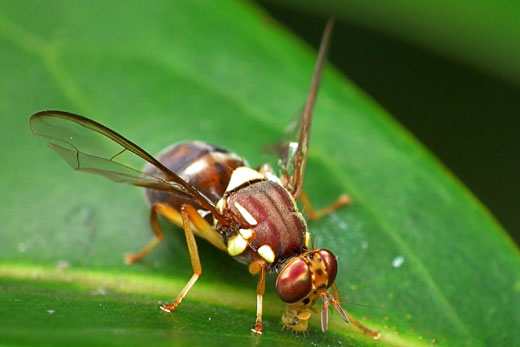
The kiwifruit industry is dismayed an isolated breeding population of fruit fly has been found but remains confident it can be contained and eradicated.
Peter Ombler, chairman of Kiwifruit Vine Health says the discovery of a second adult Queensland fruit fly, 39 larvae and one fruit fly pupa in Grey Lynn is concerning but it appears to be an isolated population.
Another fruit fly has been found in Auckland.
Nine kiwifruit industry personnel from the Bay of Plenty are heading to Auckland to assist the Ministry for Primary Industries in its response to the discovery of the unwanted insect and Peter says they have been on standby since the first adult fry was trapped on Monday.
The second adult female was found by a resident of the higher-risk Zone A in the middle of the existing controlled area in a lemon tree on his property. He captured it and reported it to MPI.
'That the second fly was found by a member of the public is heartening. In a country our size we need four and a half million people watching out for our bio-security. We all have a part to play in helping keep out unwanted pests,” says Peter.
MPI has confirmed that an isolated population of the Queensland fruit fly has been found in the Auckland suburb of Grey Lynn within 200 metres of the trapping of an adult male on Monday.
The fly was formally identified as a recently-emerged un-mated female adult fruit fly. This is the only fly that has been found, over and above the initial trapped fly found earlier this week.
Chief Operations Officer Andrew Coleman says thanks must go to the resident who captured and reported the fly, allowing MPI to act swiftly to scope the problem.
'Our investigators immediately visited the property concerned where they found lemons and plums containing Queensland fruit fly larvae. In total, at close of operations last night, MPI confirmed that one fly, 39 larvae and one pupa had been found at the property.”
The Ministry and its response partners, including GIA signatories, Tauranga based Kiwifruit Vine Health and PipfruitNZ, are now deploying significant resources to respond to this localiseddetection.
'We have every confidence that treatment will quickly and effectively eradicate this population. We have successfully eradicated previous incursions of fruit fly – notably the Mediterranean fruit fly in Auckland in 1996.”
Andrew says initial treatment will involve placing bait in fruiting trees to attract and kill female fruit flies. The bait will be applied high up in trees and plants, away from children or pets.
'A second line of treatment will involve some targeted ground-based spraying of areas under fruiting trees where positive finds have been made. This involves using an insecticide that is safe for use in residential areas and has been proven to do no harm to people or animals such as family pets or livestock.
'No use of aerial spraying will be required.”
MPI advises members of the public that the existing controls on fruit and vegetable movements remain largely the same with the previously defined wider Controlled Area remaining the same. The only change is to the scale of the higher-risk Zone A which has been slightly extended. This will be communicated to the Auckland public as soon as possible.
The instructions for residents inside the Controlled Area also remain the same – whole fresh fruit and vegetables (except for leafy vegetables and root vegetables) cannot be moved outside of the defined area. This is to ensure that fruit flies are not spread outside of the area.

0 comments
Leave a Comment
You must be logged in to make a comment.