


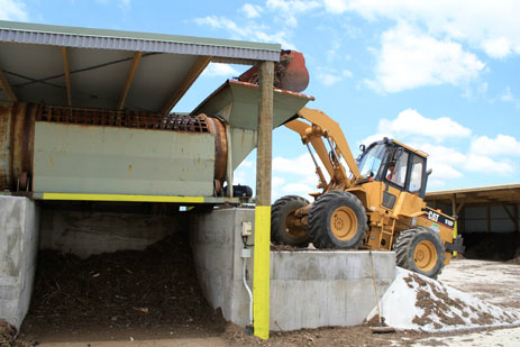
Operations at Whitianga's Biosolid Composter will cease in November while the Thames Coromandel District Council looks at how it can improve its financial viability.
A decision to either reinstate operations or decommission the plant, which mixes green waste with biosolids mainly from the Whitianga Wastewater Treatment Plant, will be made by April 2015.
The Biosolid Composter in Whitianga will cease operations in Novemeber. photo: TCDC
Infrastructure Manager Bruce Hinson says the composter has shown good operational results and is producing grade Aa compost which has been used on Council parks and reserves.
'We now need to do a more in-depth assessment on its cost benefits.”
As part of the 2015-2025 Long-Term-Planning, TCDC has reviewed the viability of the Composter and commissioned an independent report to assess the cost benefits.
Presented to council's Infrastructure Committee this week the report states there is no significant financial benefit to retain the composting operation.
It looked at the original 2007 Business Case for setting up the Composter, plus the modelling several different scenarios.
These scenarios compared sending waste to landfill or using the Biosolid Composter and the report shows that it is cheaper to send waste to landfill.
'The original 2007 Business Case said the Composter would save money by taking biosolids out of landfill and turning it into compost.
'It assumed that landfill costs would increase and the fact is, this just hasn't happened.
'The amount of compost the Plant is producing, while being used on our parks and reserves, right now doesn't financially justify its on-going operation costs.”
Bruce says it was costing the council more to produce compost from the Biosolid Composter than what it could buy commercially.
Mayor Glenn Leach believes the prudent thing to do was to stop the Composter now and re-evaluate its viability to see if there is financial benefit turn it back on.
He says council needs definite figures around volumes and costs for producing the compost, as well as understanding the financial implications more fully if it is turned back on or decommissioned.
If a robust market can be identified this would make the composter more viable but it is not clear that this market exists and further investigations into this are underway.
HISTORY OF THE BIOSOLID COMPOSTER
The Biosolid Composter Project stemmed from a business case back in 2007.
The case looked at how council could sustainably manage and investigate environmental benefits using biosolids taken from Wastewater Treatment Plants on the Eastern Seaboard.
Biosolids were being taken off the Coromandel to landfill at a cost and investigations found mixing biosolids from the Treatment Plants with green waste, like mulch and grass, could produce Grade Aa compost.
It also found that in the long-term money could be saved as it was assumed landfill costs would increase.
An 18-month temporary trial was set up in 2009 in Tairua of the Biosolid Composter to see if it could produce Grade As compost that council could use on Parks and Reserves, which was successful.
The plant was moved to a permanent site in Whitianga in August 2012. Part of the resource consent was that Grade Aa compost had to be made and for the first eight months could only be used on parks and reserves.
To read the independent report on the viability of the Composter click here and go to page 16.

0 comments
Leave a Comment
You must be logged in to make a comment.