


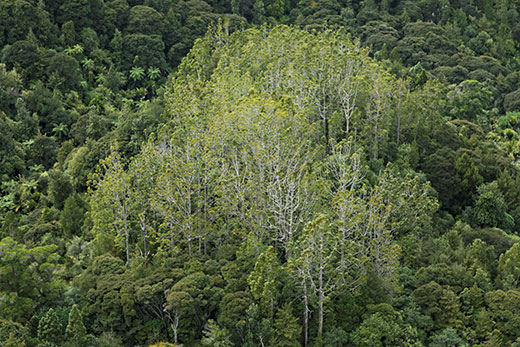
Results of aerial and ground surveillance of the Coromandel Peninsula show the presence of Phytophythora taxon Agathis – or kauri dieback disease – isn't widespread in the area.
Conservation Minister Dr Nick Smith and Primary Industries Minister Nathan Guy announced the results today, saying they were seriously worried with the disease was more widespread through the Coromandel after discovery of kauri dieback in Whangapoua Forest in March.
Trees with kauri dieback near Whitianga.
'The results of the extensive surveillance show the disease is confined to a small area with a low risk of spread and it has most likely been present for several decades,” says Nick.
Kauri dieback disease is caused by a microscopic, fungus-like organism, which infects the tree's roots and damages tissues that carry nutrients and water within the tree, effectively starving it to death.
It was first detected on the Coromandel Peninsula in March in the Whangapoua Forest, just north of Whitianga.
The area was immediately closed to the public to reduce the risk of spreading the disease, and a comprehensive aerial and ground surveillance programme was initiated.
The programme's results have been released today and show the disease has only been confirmed on two sites on the Coromandel – at the initial site in the Whangapoua Forest, and at another site on private land nearby.
'It is fortunate that the characteristics of the affected area will make it easier to contain the disease,” says Murray.
'There are no walking tracks and access to the area is limited. The area will remain closed while the discussions continue with the local community, mana whenua and adjoining landowners on the long term management options for this site.
'The pattern of disease and history of these two sites suggest that the pathogen causing kauri dieback was likely spread to the area by the New Zealand Forest Service decades ago during the establishment of the commercial pine forest at Whangapoua,” says Murray.
Historic NZFS activity has also been implicated in the spread of kauri dieback to other infected sites in Northland and Auckland.
Nick says the Government is committed to doing everything practically possible to protect NZ's kauri forests from PTA. Funding was first applied for in 2008 but declined by the previous Government.
'We have funded a programme of $4.7 million in Budget 2009 over five years and Budget 2014 provided a further $26.5 million over the next five years.
'We have also provided this month a $57,000 Community Conservation Partnership Fund grant to Kauri 2000 trust to help raise community awareness of the problem,” says Nick.
'Kauri is an iconic species for New Zealand and one of the oldest and largest organisms on earth. The Government is committed to ensuring its survival for the enjoyment of future generations.
'We ask the public to do its part to avoid spread of the disease. This means adopting biosecurity measures of cleaning and disinfecting footwear, vehicle tyres and machinery when moving to or from any kauri forests. We also urge walkers to keep to formed tracks.
'We need to take a precautionary approach of assuming every kauri stand may be infected,” says Nick.

0 comments
Leave a Comment
You must be logged in to make a comment.