


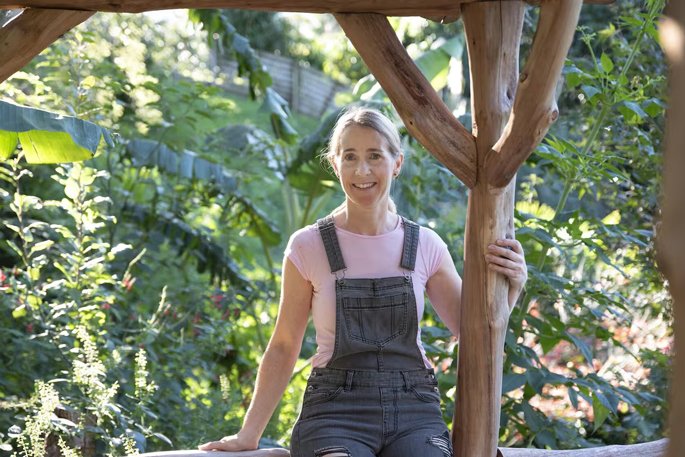
The term “food forest” describes a way of growing food that mimics natural ecosystems, rather than traditional orchard-style rows.
For Selena Hardman, it has become both a passion and a community project.
The Welcome Bay radiation therapist moved to a one-acre (0.4ha) property in Tauranga with her young family four years ago and has spent much of her spare time transforming the land into a thriving food forest while sharing her successes and setbacks with others interested in growing their own food.
“My family has always been into growing food. My mum has a vege garden, and I’ve always put in veges and fruit trees wherever I’ve lived,” Hardman said.
“The Tauranga area has a great climate for growing food.”
The vision
The property offered plenty of potential from the start.
“Our one-acre property has a steep gully with a shadier side and a sun-trap, northeast-facing slope. It had some scrappy tall trees and some mature fruit trees including lime, mandarin and lemon trees, along with Luisa plums and avocados.”
The combination of sunny and shaded areas created opportunities to grow a wide range of fruit trees, shrubs, vines and edible plants.
 The greenhouse was built by Selena’s partner Rowen from upcycled windows and wood. Photo / Catherine Fry
“You can’t just plant. You need a system and a plan, alongside knowledge of the different plants and their requirements. There is a process to follow, and it starts by understanding your land.”
Hardman credits partner Rowen Hardman with helping bring the vision to life.
“My partner Rowen does all the building work. He’s put in paths and steps to make it easier to navigate the steep gully.”
Using salvaged materials, he built a 7.5m by 3m greenhouse from old windows and timber destined for a burn pile, as well as a 10m by 3m polytunnel. More recently, he has added a rustic viewing platform and installed two beehives.
Where to start
From the beginning, Hardman used a garden mapping app to record what was planted, when it was planted and when it was expected to fruit.
“It’s important to know where, when and what was planted. After planting more than 370 fruit trees, excluding the bananas, vines and berries, I’m really glad I used the app.”
Establishing a food forest can be expensive, so Hardman grows many of her plants from seed.
Her enthusiasm for growing food led her to start the Facebook group Food Forests Tauranga, which has grown to more than 1200 members.
The group shares knowledge through visits to members’ food forests, plant swaps and seasonal tastings.
“We get to try fruit, talk about local growing and swap plants. I’ve picked up some more unusual species.”
Hardman enjoys experimenting with rare fruit varieties and testing the limits of what can be grown in Tauranga’s climate.
 Colourful bantams forage all day and supply the family with eggs. Photo / Catherine Fry
Managing the forest is an ongoing process, particularly as larger canopy trees affect the plants growing beneath them.
“If any plant dominates, I review it.”
Vegetables require more planning, especially crops such as asparagus and seasonal produce that need regular harvesting. Others, including pumpkins, are left to sprawl through the garden.
“Perennials like Okinawa spinach can be foraged for, and Malabar spinach climbs wherever it’s planted. From December to May we can harvest tomatoes, so that’s six months of fresh tomatoes.”
Her latest project is a covered berry garden on the property’s north-facing slope.
Maintenance and harvest
Hardman aims to keep irrigation to a minimum, relying largely on natural systems to maintain soil health and moisture.
“I use chop and drop for keeping the soil covered and to deter weeds.”
Fast-growing plants such as comfrey and tithonia, also known as Mexican sunflower, are regularly cut back and left in place to return nutrients to the soil.
Rather than importing manure, the plants provide a natural source of nitrogen and potassium.
The property also features a compost bin, worm farm and a flock of bantams, whose manure is composted before being used in the garden.
The food forest now produces more than enough fruit and vegetables for the family’s household of six.
“They all participate in foraging and tasting, and enjoy year-round frozen smoothie ingredients and preserves from the excess.”
Surplus produce is donated to the Welcome Bay Community Centre and shared through Tauranga Crop Swaps.
“Our goal is to create a diverse, seasonal system that produces food year-round while supporting a thriving ecosystem,” Hardman says.
“We love showing people around and seeing them enjoy the sensory experience in a calm, natural environment.”

0 comments
Leave a Comment
You must be logged in to make a comment.