


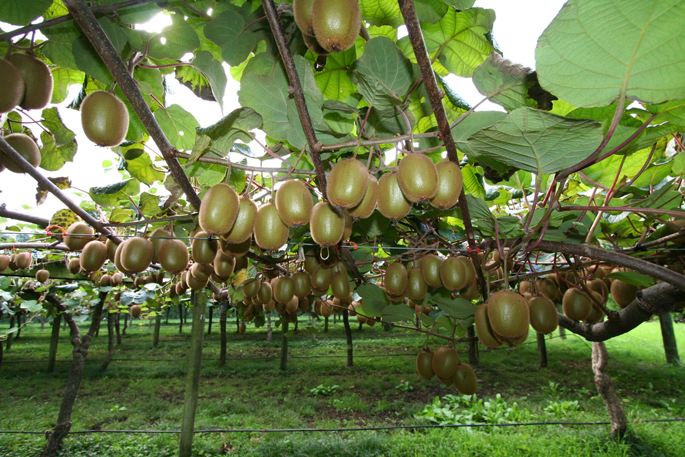
A fresh wave of kiwifruit orchard conversions is sweeping through the Bay of Plenty as strong returns and growing global demand drive investors, corporates and existing growers to secure more land.
Rural real estate agents say demand for kiwifruit properties is showing no signs of slowing, with dairy farms increasingly targeted for conversion and avocado orchards also being bought for redevelopment.
Bower Real Estate rural sales adviser Conrad Headland said the sector had rebounded strongly after several difficult years.
“Demand seems to be insatiable,” he said.
Strong export markets and favourable growing conditions have delivered bumper harvests and renewed confidence, fuelling a rise in conversions.
Headland said scale had become increasingly important, particularly for corporate investors.
“Instead of 10-hectare blocks, they are after 50-hectare properties.”
While some family-owned operations were expanding their existing holdings, syndication had also become a popular pathway into orchard ownership.
Most conversions involved dairy land, although some dry stock properties had also changed use.

Bower Real Estate rural sales adviser Conrad Headland.
In the year to October, multiple agencies sold nine avocado orchards for conversion to kiwifruit. About 100 horticultural properties changed hands across Tauranga and Western Bay of Plenty.
Headland said growers who had approached farmers about conversions a decade ago were now seeing the benefits.
Returns had climbed to about $200,000 per hectare, compared with around $45,000 per hectare for dairy operations, he said.
Most of the activity had centred on the “golden triangle” of Te Puke, Pongakawa and Paengaroa.
“The triangle is expanding.”
While it takes about three years for a newly developed orchard to produce a crop, Headland believed conversions would continue.
Avocado sales
Trueman & Co director Brent Trueman said strong confidence in the kiwifruit sector was driving the sale of larger avocado orchards and attracting buyers to dairy and dry stock properties.
The economics made conversion attractive, he said.
Purchasing an existing avocado orchard could cost about $350,000 per hectare before redevelopment costs, compared with $100,000 to $150,000 per hectare for dairy or sheep and beef land.
“It makes dairy farms attractive.”
For growers without succession plans, selling to kiwifruit investors often made financial sense, Trueman said.
He said confidence had returned following challenges associated with Covid-19, labour shortages and severe weather events.
“It’s settled down.”

Trueman & Co director Brent Trueman.
Strong recent returns, positive forecasts and new kiwifruit varieties had all helped revive the industry.
“There’s a bright outlook.”
Trueman said corporates and syndicates were becoming increasingly active in the market, while some dairy farmers were converting all or part of their properties.
With much of the land north of Tauranga already committed to horticulture, kiwifruit development was spreading east from Te Puke towards Whakatāne.
Farm conversions
Bay of Plenty Federated Farmers president Brent Mountfort said he had seen a growing number of dairy properties converted to kiwifruit, with some farmers carving off parts of their land to diversify.
“It has become quite a thing.”
Mountfort, who runs a sheep and beef farm near Matatā, said horticultural expansion was increasingly visible across the region.
“I see a whole lot of plastic [kiwifruit canopies] as far down as Edgecumbe.”
He said corporates and syndicates appeared to be leading the shift.
“It’s simply down to who can pay the most.”
Despite concerns about the loss of productive farmland, Mountfort said he had few objections to the conversions because the land remained in food production.
“That’s a plus.”
He said Federated Farmers was pushing for greater horticulture representation within its Bay of Plenty structure.
“We need to change with the times.”
Industry forecasts strong growth
A Zespri spokesperson said growers and landowners would continue to make their own decisions about land use, but positive long-term prospects for kiwifruit were encouraging investment.
“With the long-term outlook for kiwifruit positive, and global demand for high-quality nutritious kiwifruit increasing, we’ve seen a number of growers and landowners considering switching crops to invest in kiwifruit.”
The spokesperson said Zespri remained focused on keeping demand ahead of supply to deliver long-term value for growers and communities.
New Zealand Kiwifruit Growers Incorporated chief executive Colin Bond said horticulture was outperforming many traditional land uses.
The sector is forecast to generate $9.5 billion in export revenue in 2025-26, rising to $10.8b by 2029-30.
Much of that growth is expected to come from kiwifruit, New Zealand’s highest-value horticultural export.
Kiwifruit export revenue is forecast to increase from $2.8b in 2024-25 to $4.2b in 2025-26, before reaching $5.3b by 2029-30.

0 comments
Leave a Comment
You must be logged in to make a comment.