


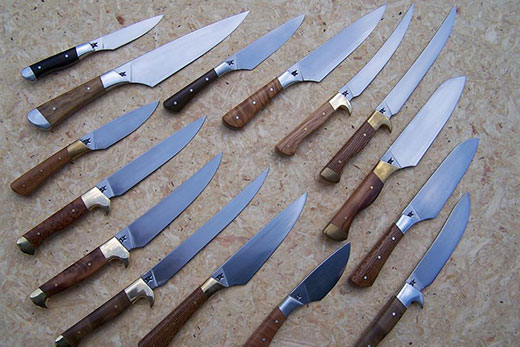
Lloyd Franklin turns old car springs into knives – and if that sounds like some form of alchemy – in a way it is.
For 27 years he's been using the ancient techniques of a blade smith, heating, cooling and hammering, to transform modern steel spirals, not into gold, but into razor sharp knives.

From an old car spring to a high quality knife – the craft of Lloyd Franklin. Photo by Brian Rogers.
'Car springs are made from modern high tech steel, which is freely available and can be heated and shaped using traditional methods,” says Lloyd, who makes and sells knives from his roadside workshop at Kuaotunu near Whitianga.
'We're full of clichés round here – like making a silk purse from a sow's ear – keeping the nose to the grind stone – and striking while the iron's hot – but they are all true of this business.
'People like the fact I'm recycling steel and many of my sales are prompted because of that fact.”
Lloyd was a cabinet maker before he taught himself to forge knives. 'Teaching yourself means you don't learn anyone else's bad habit; and you're not limited by their techniques either.”
While the steel source is modern, almost everything else about Lloyd's knife making is traditional. He burns West Coast coal in his forge, heating it until impurities are burned off and it becomes coke, so achieving temperatures sufficient to heat the steel to a point where it's malleable.
'I work with the extruded grain of the steel, working in the round to draw out and build a spike, and then draw the blade out of the spike. The rounded edge of the rod forms the top and cutting edge of the knife.”
While some smiths work up to white-hot steel, Lloyd doesn't need to achieve those temperatures.
'As the knife gets closer to being finished, I work within the lower heat range but initially start at orange working down through the red and finishing at dull red.”
He uses five different hammers to shape the blades on an anvil, alternatively and repetitively putting corrugations in the steel and smoothing it out, working with the grain to achieve the shape he wants.
A series of accidents – not in the workshop – have left Lloyd with a number of injuries, including one to his shoulder.
'I was supposed to have surgery but was told if I did, I'd never forge again; and if I can't make knives, how do I make a living?”
So he puts up with the pain and continues to hammer out knives for chefs, for carving; for filleting fish; and for hunting.
Some have silver and pounamu (greenstone) handles. Whale bone, beef bone and deer antler are also used.
'Fifty per cent of my work goes overseas. That's one of the reasons I decided to make knives, because they are small enough to fly around the world,” says Lloyd, who not only delights tourists and locals alike with his craftsmanship, but also his ready wit.
'I'll never make my fortune in this job but I find myself continually socially entertained by the people who visit me. They often thank me when they leave, because they've had a good laugh, and so have I.”

0 comments
Leave a Comment
You must be logged in to make a comment.