


The possibility fruit flies found in Whangarei could have been deliberately placed in traps is unlikely, according to the Ministry for Primary Industries.
Two Queensland fruit flies have been discovered in Whangarei this year – the first in January and the second in a surveillance trap, set up in response to the first find, earlier this month.
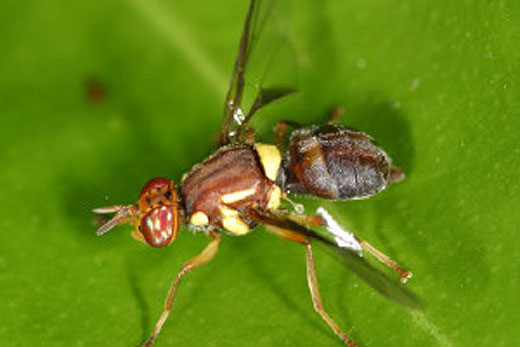
An example of a female Queensland fruit fly. Photo: Supplied.
The Ministry's Deputy Director-General of Compliance and Response, Andrew Coleman, says the fact that no other flies have been detected is not evidence of a 'plant”, but the Ministry has not ruled out the possibility the insect has been deliberately introduced to NZ.
'Upon detection of a fruit fly in a surveillance trap, MPI's entomologists examine the captured fly to determine both its identity, and also to determine whether there is any evidence to suggest the fly is a 'plant”,” he says.
Historically the majority of fruit fly detections in New Zealand have been of single flies; the exception being the detection of a breeding population of Mediterranean fruit fly in Auckland in 1996.
Andrew says the Ministry is taking a close look at a range of potential entry means, or pathways including passengers, yachts, fruit imports and possible deliberate introduction.
'None of these options can currently be ruled out. It is too early to comment on the specifics of our investigations underway.
'MPI's immediate priority is running its extensive trapping and fruit examination programme to ensure that no breeding population of the fruit fly is present, and if more are found, to eradicate them as quickly as possible.”
Fruit flies are very small insects, but both the find in January and this current find were confirmed as the Queensland fruit fly (Bactrocera tryoni) by visual identification by MPI's entomologists. DNA results have also identified the insects as Queensland fruit fly.
To date no other fruit flies have been found in the area and it's possible the current operation could end this weekend.
MPI runs responses to the detection of a male fruit fly in a trap in accordance with an internationally-accepted Response Standard.
This standard requires that the response trapping network and movement controls must be in place for a full 14 days from the time the last trap was deployed. In this case, that was Saturday April 5.
'If, after that period, no further fruit flies have been detected through the trapping, or the analysis of fruit from the Controlled Area, MPI has the discretion to close out the response and end the movement controls.
'The earliest the controls could be lifted and the response stood down would be Sunday, April 20.
'However, we still have several days of testing to run and we cannot confirm as yet exactly when the response will end. MPI will advise the local community as soon as possible of the end to fruit movement restrictions,” Andrew says.
Once the response is over, as a precautionary measure MPI plans to have an enhanced trap presence in the area as a part of its on-going national surveillance programme.
If further flies are found MPI has a range of measures to deploy. The first would be putting out ‘lure and kill' bait traps, which would attract both male and female flies, ground spraying of insecticide to kill any pupae in the soil and spraying host trees with insecticide to kill any adults.
Andrew says these sprays, applied from the ground, would be pyrethrum-based products with a similar active ingredient to household fly sprays.
Another possible method of control is to release sterile males to breed with females, so that they don't lay fertile eggs.
'The use of sterile males is reserved for situations where large populations are present, as is currently the case in Australia. We are not looking at a situation like this. MPI runs a comprehensive fruit fly surveillance programme to detect the presence of fruit flies at an early stage before any population can widely establish.”

0 comments
Leave a Comment
You must be logged in to make a comment.