


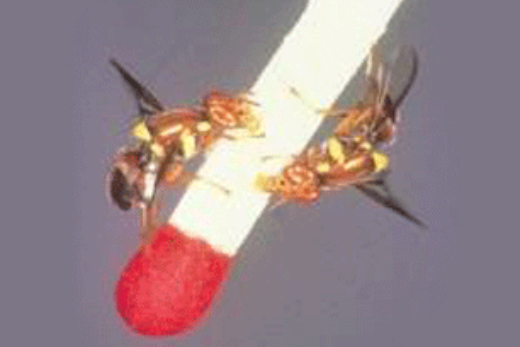
New Zealand needs to urgently look at how it is managing its biosecurity risk following the discovery on Tuesday of another fruit fly in Whangarei.
That's the view of Horticulture New Zealand chief executive Peter Silcock, who says it is unbelievable and unexpected that the country is faced with another Queensland fruit fly detection, so soon after the last one in January.
There have now been three detections in less than two years. Prior to May 2012, there had not been a Queensland fruit fly detection in New Zealand for 16 years.
'We have confidence in our system to detect any fruit fly at a very early stage and this system is critical for maintaining international market access for our products.
'But we do have to urgently look at how we are managing the biosecurity risk, so we don't keep finding this pest in our traps.”
Kiwifruit Growers Inc Neil Trebilco says there is heightened concern over this discovery as the kiwifruit harvest is underway and if a population of the insects is found, that could impact on exports.
Back in January, Neil warned that now Australia has changed its internal measures to control fruit fly, growers could expect to see more discoveries of insects in this country.
Australia has relaxed movement controls between states designed to reduce the risk of spreading fruit fly because moves to create fruit fly free areas have not succeeded.
'This latest find highlights that we need to have a really good look at what is coming into New Zealand, both with international passengers at sea ports and which is coming in via imported fruit and vegetables.”
Both insects were trapped close to the Whangarei marina, which raises speculation they may come from private vessels arriving in New Zealand.
Neil says he believes the Ministry for Primary Industries has been considering increased surveillance of these boats.
'It is possible to have an MPI officer and detector dog meet every arriving boat and we would certainly encourage MPI to consider doing that.”
Fruit fly pose a threat to other horticultural crops, including avocados and to home orchards too.
'Home gardeners don't want fruit fly to establish here as it would have it very hard to grow fruit.”
Neil says the next 72 hours are critical for the surveillance teams, who will be hoping no more unwanted insects are found, which could indicate there is not a breeding population in the area.
Peter says this current find is a serious situation for the entire New Zealand horticulture industry and also for all home gardeners.
'This is a pest that we don't want because it will impact on our ability to grow things, export produce and on the 50,000 jobs this industry provides across New Zealand. It is in everyone's interest to keep this pest out.”
HortNZ knows this will be a tiresome situation for the local residents again caught in the immediate exclusion zones around where the fruit fly was found.
'But it's very, very important that they don't take fruit out of the control zone or swap or give fruit away to friends as often happens at this time of year.
'The two things that need to happen right now are firstly MPI needs to get the traps out in the immediate vicinity of this find and put in place measures to control the movement of host material. We are happy that MPI is swinging into action on that,” Peter says.
Residents in the control zones face at least two weeks' of disruption MPI places controls on the movement of whole fresh fruit and some vegetables out of a specific area of Whangarei.
Andrew Coleman, MPI Deputy Director-General, Compliance and Response, says all information at this stage indicates that this detection is a new find and not related to the January incident.
'The Whangarei community were immensely supportive of our efforts earlier this year and we anticipate they will be again. It is, of course, disappointing that this situation has recurred.”
The legal movement controls, set out in a Controlled Area Notice, are an important precaution while MPI investigates whether there are any further fruit flies present in the area.
'Should there be any as yet undetected flies out there, this will help prevent their spread out of the area.”
The Queensland fruit fly is an unwanted and notifiable insect that could have serious consequences for our horticultural industries and home gardens.
The Controlled Area Notice is in force for a 1.5km circular area around the location of the find, taking in parts of Parihaka, Riverside and central Whangarei.
This description is approximate and detailed maps of the controlled area, a full description of the boundaries and full information about the rules are at: www.mpi.govt.nz
Whole fresh fruit and vegetables (except for leafy vegetables and root veges) cannot be moved outside of the Controlled Area.
Within the wider Controlled Area there is a smaller central Zone A (which takes in a circle 200 metres out from the initial find), and whole fruit and vegetables cannot be moved outside of this Zone at all. Fruit and vegetables can continue to be transported from outside the Controlled Area into the Controlled Area.
Key fruits, vegetables and plants of concern are:
All citrus fruits, all stonefruit, pears, apples, blackberry, boysenberry, grapes, feijoa, passionfruit, tomato, eggplant, capsicum, pumpkin, avocado, custard apple, quince, persimmon, loquat, olives, oleander, kumquat, crab-apple, cape gooseberry and guava.
Residents are asked to avoid composting any of these risk fruits and vegetables. For disposing of fruit and vegetable waste, they are encouraged to use a sink waste disposal unit if possible. MPI is providing special bins in the Controlled Area for the disposal of fruit and vegetable waste. The locations of these bins will be advised shortly.
'We appreciate this will be inconvenient for the many people living in and around the Controlled Area, but compliance with these restrictions is a critical precaution to protect our horticultural industries and home gardens,” Andrew says.
'It is expected the restrictions will be in place for at least a couple of weeks.”
MPI and its partners have deployed investigators in the affected area. They will be laying traps and checking fruit trees, vegetable gardens and rubbish bins for any signs of fruit flies.
'It is vital that we ascertain if the insect is a solitary find or if there is a wider population in Northland which would need to be treated,” Andrew says.
If further fruit flies are found, the Ministry says there will not be aerial spraying of insecticides as there are other more effective treatment methods available.
Full information will be regularly updated on www.mpi.govt.nz http://www.mpi.govt.nz/> .

1 comment
Biosecurity !!!!
Posted on 03-04-2014 21:30 | By The Caveman
The bottom line is that these fly's are now here and somewhere in Northland (in the area Whangarei area) a small colony has been established. The so called biosecurity in this country is hopeless - lots of words etc. and no actual action - and I have first hand experience of this.
Leave a Comment
You must be logged in to make a comment.