


The first kiwifruit of the 2014 season are on the way to Japan, marking the start of a season which should harvest 16.5 million trays of gold and 65 million trays of green fruit.
New Zespri variety Sun Gold.
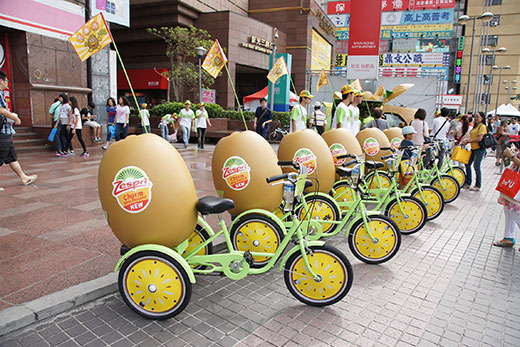
A Zespri promotion in Taiwan for the new variety called Charm.
Though down on the total of 98.5 million trays exported in the 2009-2010 season, it's still a remarkable achievement given the impacts of disease Psa-V on orchards since 2011.
Two seasons of favourable weather conditions for producing kiwifruit, but not so conducive to the Psa-V bacteria, have brought renewed optimism to an industry which some believed would not overcome the devastation of the disease.
Orchard values have recovered, there's a quiet sense of optimism among growers and in the postharvest sector – and production is back in growth mode.
Zespri CEO Lain Jager predicts volumes of gold fruit will increase to more than 20 million trays next year, as young vines come into production. Green volumes should also recover as growers increasingly learn to manage the disease.
Orchardists hit hard by the disease cut out mature vines and grafted new gold and green varieties onto existing root stock, and green-field plantings of new varieties have also gone ahead. Virtually all of the very susceptible gold variety Hort16A has gone from the heavily-infected Te Puke region – but in other regions, including Northland, the fruit continues to grow with up to 6 million trays expected to be harvested this season. Lain says the industry has been fortunate in the growing conditions of the last two seasons.
'Last season we had a vintage year, with high dry matter and great taste, and this year's crop is looking stunning without too much pressure from Psa. Growers have really focused on how to manage Psa to protect their vines.”
However, Lain says the industry is well aware a cold wet winter could reactivate the bacteria and no one can afford to be complacent. Managing the disease is now a vital factor in growing kiwifruit in New Zealand.
Chilean kiwifruit growers, who also have the disease in their orchards, have been hit by severe frosts and their fruit volumes are down by 50 to 60 per cent, says Lain. 'It's hard to say how much of that reduction is frost or Psa-related.”
Chile's bad luck does provide market opportunities for New Zealand fruit, as there will be reduced competition from Chile.
Northern Hemisphere producers Italy, France and Korea have generally enjoyed a good selling season and their fruit should be largely out of the market by the time Zespri fruit arrives.
'The Zespri team is really excited about the season and the fact that we have a great product to sell. We have our sleeves rolled up and are working hard in the markets.”
Lain says consumers need educating about the new gold varieties Gold 3 and Gold 9 (marketed as Sun Gold and Charm) because they don't have the distinctive 'beak” of the Hort16A variety they'd become so familiar with.
'In fact some consumers think the new varieties are a counterfeit, so we have to convince them that they are Zespri kiwifruit, with the same high standards as Hort16A.
'It's a bit like a car manufacturer launching a new model.”
The Hort16A beak was a bane for pickers and packers, as its sharp end could damage other fruit. However, lack of a beak is not the only advantage the new gold Gold 3 has over is predecessor. When grown well, and picked at the correct dry matter, Gold 3 has a great taste which does not diminish over time in storage. While Lain is upbeat about the markets in 2014, he's cautious about returns because of continuing strength of the New Zealand dollar and the fact Zespri's currency hedging protection reduces over time.
But he's not letting that put a damper of the industry's achievements to date.
'As for growers, Zespri employees are enjoying being part of the industry's recovery and are looking to the future with a renewed sense of optimism and self-belief.”

0 comments
Leave a Comment
You must be logged in to make a comment.