


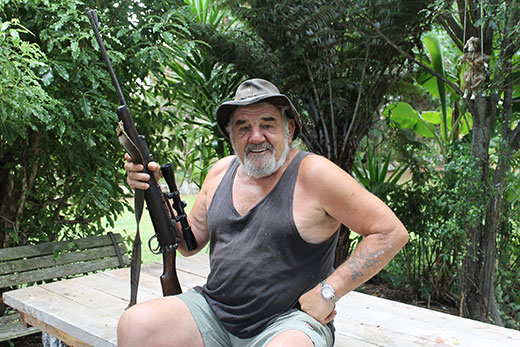
If young Lance Duncan could have made a career out of pig hunting, he would have – but in the 1960s there wasn't any money in it.
Instead he found the opportunity to keep his dogs, hunt pigs, learn new skills and eventually own his own business – in the forestry industry.
Lance Duncan has been a keen hunter since he was a teenager.
Living in Te Aroha, Lance, known to many as Louie, was aged 13 when he went on a hunting trip to the King Country with Megs Grant, who introduced him to the hunting game. He returned six days later only to find his mother had died suddenly and the funeral had already taken place.
He went to live with his uncle Tom Mortensen, who was a fire patrolman for New Zealand Forest Products in Tokoroa and also a keen hunter and breeder of pig dogs – so hunting was not going to be a problem for the good keen man.
By the time Lance was 17, he'd moved to Te Whetu, in the Mamaku Ranges between Putaruru and Tokoroa.
The Bartholomews mill was one of the country's many native timber mills, processing rimu, totara and matai; and it also owned a large Douglas fir plantation.
'There was no job for me at the mill, but I got one working for Bartholomew Timber Company, twice-a-day taking two pack horses loaded with pine seedlings into the hills for re-planting after a cocky's fire had got out of control and burnt of a large area of company land,” says Lance.
'There was no road into the area and the planters would be pretty tired after working all day and then having to walk back to their transport at knock off.”
Skiddy
Native logs were transported to the mill by a locomotive train and the tramline, which included a tunnel. It was 12 miles from mill to the bush skids.
'It was a real buzz to experience the ride to work on the jigger on the crooked line.”
Lance, by then a ‘skiddy', recalls hooking the first load that ever went out on a rubber-tired vehicle in the 1960s. The early trucks were a single-axled Austin Artic and an ex-Army GMC Long Pole. Logs were loaded using an ex-army four-wheel-drive crane truck with a scissor hook. The logs were all measured by wind-up tape and marked by axe; there was no such thing as spring-loaded tapes and cans of spray paint.
'There was no OSH [Occupational Health and Safety New Zealand], or health and safety regulations; and it was pretty dangerous work, but you got the guidance from the older bushmen,” says Lance, who fully supports today's safety equipment and regulations. However, he reckons no one can legislate for common sense and experience.
'Too many people get into the industry today with desk-learning and not enough experience. Felling trees is dangerous and they can be ‘widow-makers' – but if you think about what you're doing, you only have to step far enough sideways in most cases to avoid getting hit.
'Looking up to see what's likely to come down, or if in doubt walk away before making a cut also makes sense,” says Lance, who is now 69, still takes his chainsaw and joins a felling gang from time to time.
After working for a number of contractors, spending six months logging in Fiji, and then going into partnership with Ron Sycamore of Tokoroa to form Duncan and Sycamore Logging, Lance eventually bought Ron out and formed his own company L E Duncan Logging.
'I was always big on safety and thankfully I never had a death on my job in my whole bloody logging career, but it was one of my biggest fears. The worst injury was a broken ankle.”
Lance was chairman of the Kinleith Logging Contractors' Safety Incentive Scheme when it first started and feels scrapping safety incentives for workers, funded by the companies, was a backward step.
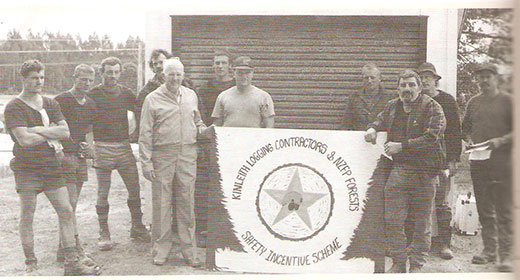
Lance Duncan (right), holding the Kinleith Logging Contractor's safety incentive scheme banner with the late Digger Evans (left), surrounded by members of Lance's logging crew.
Bonuses
'There were incentives and bonuses and the guys looked forward to them.”
Lance says he came up through the forestry industry the hard way. He started at Te Whetu and later worked for logging contractor Norm Torstonson for six pound a day, learning to operate cable blade bulldozers, the CAT D73T and D7 17A models.
Lance had married Carol Shires, the daughter of Roly, who was the mill manager at Te Whetu, then worked for Barney Walker at Galatea, running a logging gang pulling out pine trees which were skid-loaded using a cable-blade CAT 2U D8.
In 1968 Lance returned to Te Whetu to work for Nelson Pritchard thinning Douglas fir, using a HD6 tractor. The following year he took on a contract clearing native bush and scrub, the land was then burnt off and replanted in radiata pine, and in later years he went back to log the same area.
He and partner Herb Wallace were paid $26 an acre for their work.
Then Lance was offered a contract clear-felling Douglas fir, which he jumped at and brought his first bulldozer the HD6 from Nelson Pritchard, funded with $76 in the bank and Bartholomew Timbers covering his first fortnight's wages. Lance sold that contract when he was offered a job in Fiji.
Fiji logging
'My father-in-law was working as mill manager for the Emperor Mining and Logging Company in Fiji, and I was assistant logging manager,” says Lance.
'I enjoyed it and they had some good gear, but the biggest problem was the upkeep of equipment.”
Lance says local workers didn't have any idea how to maintain and care for equipment, including something as simple as checking oil levels. Lance had to cut short his contract due to one of his son's ill health.
When Lance and family returned to New Zealand, he worked for Ron Sycamore who owned Tokoroa Tractor and Logging, one of the biggest contractors in Tokoroa at the time.
Eventually, Ron made Lance a partner in the business, renaming it Duncan and Sycamore Logging, which processed pinus radiate, before he finally bought out Ron's share.
Keen to preserve the history of the forestry industry in New Zealand, Lance, Ron and Pat McDonald also helped out the Putaruru Timber Museum by donating a GMC logging truck – and Lance highly recommends a visit to anyone passing through Putaruru.
In between logging, Lance found time to enjoy pig and deer hunting, duck shooting and fishing, sharing those interests with his three sons.
Race horses
Forestry wasn't all Lance was involved in. For a time he owned and even trained race horses including Mulqueen, which was to run in the Melbourne Cup but developed a virus a week before he was due to fly over for the big race.
But Lance had successes – five of the horses he bred produced four winners and one placed numerous times.
'I was pretty proud to have a horse which was good enough to qualify for the cup, even if it didn't get to run.”
Lance got his horse experience when he was at Te Whetu rounding up the wild brumbies and breaking them in to use for pig hunting.
Lance also tried his hand at stock car racing, winning trophies along the way. He still has an interest in stock car, as his nephew Ross Ashby is a member of the Baypark Busters.
Now retired, Lance lives in Waihi where he's set up a ‘bloke's shed' – in essence a small museum with an eclectic mix of old photos of forestry days, race horses, hunting successes, a mounted boar's head and stags' antlers, a trout, trophies and other memorabilia.
Lance is currently writing a book about his working and sporting life.
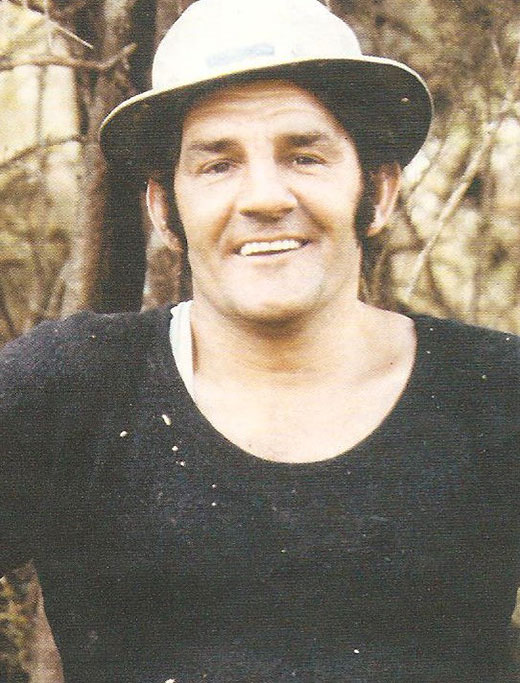
Lance Duncan, aged 37, in a photo used by Jonsered Chainsaws for publicity purposes.
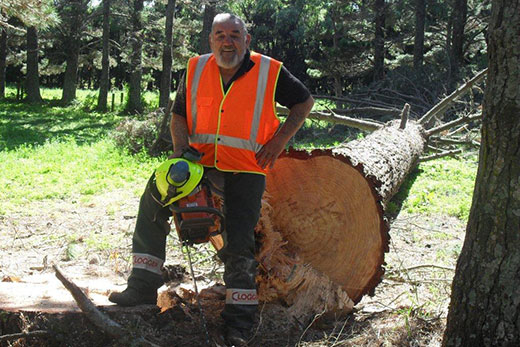
Lance Duncan joined a felling crew in December to help out a friend – he's a fan of modern safety gear and equipment.
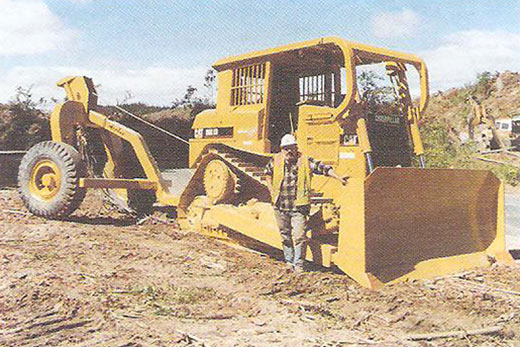
Lance Duncan's pride and joy was his 528 Grapple skidder ‘Tane Mahuta' which he bought in 1985 and used until he finished contracting in 1997.

0 comments
Leave a Comment
You must be logged in to make a comment.