


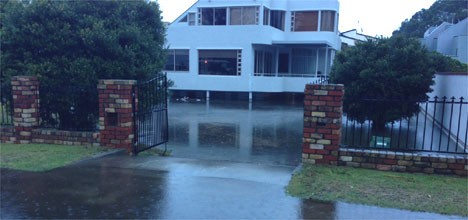
The final insured costs of the April 2013 storm which torrentially flooded the Bay of Plenty region has come to $11.5million, according to the Insurance Council of New Zealand.
Latest figures released show the total cost for both the Bay and Nelson/Tasman district sits at $46.2m after months of collating and process numerous insurance claims from the two regions.
A Mount Maunganui house is left waterlogged after the floods in April. Photo: Tracy Hardy.
Following the flooding, the Nelson/Tasman district was the most badly damaged with insured costs mounting to $33.7m – evenly split between residential and businesses.
Of the Bay's total, $7.3m worth of damage was done to residential properties, commercial damage amounting to $2.4m and motor vehicles $810,000. Insured damage in the Waikato came to $1m.
'Some areas of New Zealand have proved to be particularly susceptible to flooding and there is a risk that with climate change they will become more vulnerable in the future,” says ICNZ chief executive Tim Grafton.
'Insurers encourage communities, businesses and local government to plan and adapt in ways that will reduce the impact of natural disasters. This in turn will help keep insurance affordable for all and ensure a rapid recovery after disaster hits.”
The Bay's damage bill has climbed by $1.8 million since the insurance council's previous damage estimate in June of $9.7 million for the region.
In April torrential rain caused significant flash flooding throughout the Bay of Plenty, trapping cars and blocking roads while emergency services were kept busy overnight with more than 100 call outs to flooded houses around Tauranga, Papamoa and Mount Maunganui in a three to four-hour window.
Following the event, the Insurance Council of NZ received more than 1000 claims for damage in the Bay of Plenty in what is the most damaging storm event in the last five years, says Tim.
As a result Tauranga City Council was forced to revise its capital spending, increasing the storm water budget this year from the normal $5.53 million to $9 million.
Over the next five years, the council intends to spend an additional $43.5m on top of the annual $5.53m. During 2014/2015, the council intends to spend an extra $8.5m, followed by $15.5m in the 2015/2016 year.
The added capital and operating expenditure, following April's torrential flooding, will see council debt balloon out from $410m to $450m by 2016/2017 while rates increase from 0.6 per cent to two per cent this year.

0 comments
Leave a Comment
You must be logged in to make a comment.