


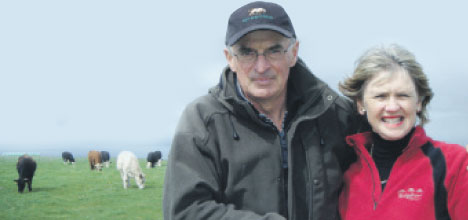
New Zealand's farming business model must be redefined if farmers are to remain profitable and waterways are to be protected, believes Mike Barton of Glen Emmreth Farm in Taupo.
With wife Sharon, Mike owns and farms a 142 ha beef finishing property on the north western shores of the lake, under the Waikato Regional Council's strict ‘Variation 5' conditions.
Sharon and Mike Barton farm under tough ‘Variation 5' conditions on the shores of Lake Taupo.
'As a nation we cannot continue to have a conversation about protecting water quality without having a parallel set of conversations that redefine the New Zealand farming business model,” says Mike, who believes science and science funding is needed to find answers.
Variation 5 means the Barton's farm is capped at 2004 production levels – but its costs have increased by 48 per cent. To stay within the imposed limits, the couple has discontinued breeding cows and need to grow young animals as rapidly as possible with no second wintering – as mature animals excrete more nitrogen.
'Now we farm on the gross margin per kg of N leached. We are in the top Beef + Lamb quintile for beef production but can't produce any more,” says Mike.
'We have to apply for consent to farm, which limits our production in perpetuity and has significant implications for farming business models and property values.
'The length of consent is the length of an average mortgage or less than one rotation of trees, but at least we know what we can do for 25 years.”
Mike says the council wanted consents which ran for just five years, but there was no way any bank would lend money under those conditions.
Branding
Sharon and Mike, and other beef farmers affected by the same rules, decided to turn what could be seen as a negative into a positive – encouraging the Waikato Regional Council to give them an environmental ‘tick' to brand their beef and achieve a premium for it.
The brand ‘Taupo Beef: grown right here', together with the certification mark from council, has proved successful.
'Consumers have paid a significant premium for our beef, sold through local butchers and restaurants. We've had outstanding feedback from chefs and diners, and demand exceeds our ability to supply.”
That success demonstrates the need to build a business model that returns a premium to farmers, Mike says.
The Bartons first became aware of moves to protect the quality of Lake Taupo's water, when nitrogen leaching restrictions were placed on farmers back in 2000. 'We desperately wanted the problems to be caused by the baches around the lake, in fact by anyone else but farmers, but in the end had to accept we were contributing to it.”
Mike says the issue is not one of poor water quality, as with many of the Rotorua lakes, but of preventing the degradation of what is one of the four cleanest lakes in the world.
Worse
The aim of Variation 5 is to return Lake Taupo's water quality to that of 2000 by 2080. But in the short term the quality may get worse because it can take 30 years for some nutrients to reach the water from the land.
Research has shown that farming emits 93 per cent of the manageable nitrogen entering the lake – and that comes from four dairy farms and 101 extensive sheep, beef and deer farms.
Tussock and native forest releases 3kg per ha of nitrogen annually, the same figure as plantation forest, while sheep and beef farms account for 17 kg/ha, and dairy tally in excess of 45kg/ha.
In response to the regional council's plans to limit leaching, the Taupo Lake Care incorporated society was formed to represent the interests of farmers, and to advocate and participate in research. The society represents 105 farms, half of them under Maori ownership.
'I know what our farm leaches because it has been part of one of the largest trials ever conducted by AgResearch, using 1000 underground water collectors.”
In 2007 another organisation, the Lake Taupo Protection Trust was set up to administer the $81.5 million fund to protect Lake Taupo's water quality, under threat from the effects of past and current land use activities.
Science
However, Mike says despite that funding, nothing new has come from the science and nothing is on the horizon to help farmers continue to farm profitably under Variation 5 restrictions.
'We are running faster and faster, but going slower and slower. We can farm under an emissions cap but will livestock numbers and classes need to be capped to do so?,” asks Mike. 'Do we accept a consequent cap on income or are we willing to invest to redefine the New Zealand agricultural business model?”
Mike warns that what has happened to Taupo farmers is not isolated – and similar caps may be imposed on farmers in other regions before too long. Pasture renewal may also not be permitted in future. 'We may need pastures which last for 100 years.”
To survive, farming in New Zealand needs re-thinking and science has a vital role to play in helping farmers remain viable, says Mike.
'We cannot continue to occupy the commodity agricultural market place and mandate catchment nutrient caps and biodiversity protection.
'How do we establish brand values that facilitate and fund the achievements of these environmental goals and farm profitably?
Too cheap
'We must sell food at the true price of production. We have been selling it too cheap,” says Mike.
Farming's immediate needs from science include a focus which sees all science outputs described as the dollars in profit per kilogram of nitrogen leached. All science outputs must be embedded in the Overseer programme so farmers can use them.
There is a need for the selection and breeding of more efficient converters of grass to protein, and cropping and pasture establishment systems which leach less nutrients.
Consumers must be involved and informed about food and water quality. They should be asked if they actively seek out food that is produced in a manner that protects water quality; if they know the source of such food; what premium they are prepared to pay for that food; and is that the real test of how much they value water quality?
Eating, says Mike, is the final agricultural act.
# Mike Barton was among speakers at the Beef+ Lamb New Zealand Farmer Road Show at Ruakura in June.

0 comments
Leave a Comment
You must be logged in to make a comment.