


Free accommodation and all they can eat are what the 1.2 billion workers of an innovative North Island company require, says their boss Michael Quintern.
It's easy to keep our worms happy, says Michael, and their productivity is pretty impressive, but then so too the size of the operation.
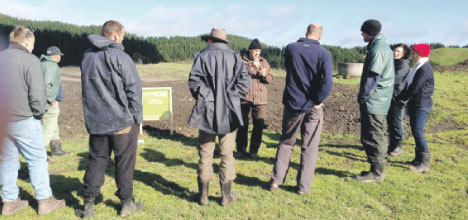
Worm at work – although out of sight – MyNOKE hosts regular field days to explain how effective worms are at converting waste into useful products.
MyNoke's worm farms cover a total of 50 ha across four sites – and every year its worms convert some 150,000 tonnes of waste, which would otherwise go to landfill, into high quality products.
The company has grown out of research Michael did as scientist in Germany and while working as technical manager of the New Zealand Land Treatment Collective at Scion, the forest research institute, in Rotorua.
There he was inspired by the ability of worms to convert what had previously been waste, into premium soil conditioner for farming and horticulture – a process he calls 'up-cycling” rather than recycling. He also refers to organic waste as 'organic residues”, in an effort to overcome the false impressions often associated with the word 'waste”.
The first large scale worm farm Michael designed and established was for Tuaropaki Trust, at Mokai near Taupo, to process some 2000 tonnes of greenhouse waste.
It was this experience which led to the name MyNOKE. 'Noke is the Maori word for earthworm, so as my first large scale worm farm was for a Maori trust, that name seemed appropriate.”
Michael then established the Ecocast Wormfarm with two partners at Kawerau and which was followed by the MyNOKE flagship worm farm at Kinleith/Tokoroa. A smaller worm farm was designed and is serviced for Laminex, the laminates and panels division of Fletcher Building Products Ltd, in Taupo. Last year, Michael designed the on-site worm farm for the new Maketu wastewater treatment plant, and provides operational and management contract support of that facility for Western Bay of Plenty District Council.
Lost fibres
The worms are fed on ‘lost' fibres from paper mills, sediments from oxidation ponds of wood processing industries, kiwifruit wastes, farm manure and effluent, bio-solids from wastewater treatment plants, by-products from milk plants, meat plants, kitchen wastes, and paper wastes from restaurants and hotels.
Michael is unashamedly a fan of worms which he describes as nature's smartest technology for enhancing soil fertility. 'Worms are basically five centimetre long tubes which swallow food that passes into the gizzard, a bit like the gizzard of a chicken, where it is ground down into organic matter.”
As part of the digestion process, pathogens are destroyed and converted to less harmful complex organic compounds, phosphate is made plant available, and plant growth stimulators such as auxin are added. The result is a product called wormicast, one third of which is humus.
Large scale
The worms on the MyNOKE farms live in low windrows, (some of them in the pine forest at Kawerua) and are fed a constant supply of organic material. At Tokoroa, the operation is so big a new Claas Axion 850, 200 hp tractor has been bought, along with a new JCB 500-80 Loadall which can lift five tonne up to eight metres high, along with a number of other mixing and spreading implements.
As well as vermicast, MyNOKE sells earth and compost worms and bark mulch. Its vermicast product has replaced peat in hydro-seeding of grass on banks along newly widened roads. The company's successes in turning organic residues into useful products has attracted attention from industry and municipal councils from Australia and Chile.
Michael, who grew up on his grandparent's farm in Germany, is the founder and a director of MyNOKE. After completing an apprenticeship in farming, he studied agriculture and soil science and did a PhD in agriculture – soil sciences on land utilisation on organic wastes on farmland. Seven years ago he and his family immigrated to New Zealand.

0 comments
Leave a Comment
You must be logged in to make a comment.