


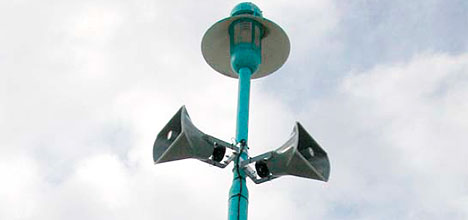
The two companies competing on the drawn out process for a tsunami-safe Papamoa community remain divided on Tauranga City Council's original costing requirements.
At Monday's meeting, organised by the Papamoa Progressive Association, siren installers Meerkat Alert Systems Ltd and Tactical Tooling Ltd each had half an hour to discuss the merits of their systems to the public.
Since 2005 Papamoa residents have been promised tsunami sirens – and since then three systems have been proposed and scrapped by council.
Meerkat Alert Systems managing director Wilfried Roding says council's original costings were too low, with their costs submitted on the revised design coming to about $1.5million. It is believed council received a grant for $805,000 for the installation of the system.
'These costs included some additional system options and modifications which were not included in the original tender. This cost was well over the council's budget,” says Wilfried.
'We also argued that the figure of $200,000 and six sirens, put forward by Tactical Tooling, is not realistic. Their system would also cost about $1.5m.”
Meerkat was the council's preferred tenderer before the plug was pulled on the sirens for the third time. Tactical Tooling is the supplier of the air raid sirens, used in a live demonstration last October.
The company's current projects include catering for Auckland City Council, Christchurch City Council and Timaru District Council.
Wilfried says the company has a long association with Tauranga, after testing their first prototypes in Mount Maunganui, and remains hopeful council will rethink their decision.
'We have planned various siren layouts for them [council] and that unfortunately culminated in council pulling the plug. I don't believe they have pulled the plug entirely but will hold workshop with the possibility to maybe resurrect the project.”
Former Papamoa Progressive Association chair Steve Morris says the big issue is resource consent, because in the Tauranga District Plan tsunami sirens is not a permitted activity as with other parts of New Zealand.
Both were critical of council requirements, stating they are 'a bit of an overkill”, but are happy to continue working with council.
Council restrictions on minimum and maximum sound levels were allocated to 75dB and 100dB within 25m of the pole. This was subsequently amended to 75dB for 80 per cent of each siren's coverage area, with the balance at 70dB for resource consent.
Wilfried adds a council resource planning department meeting revealed many of the proposed sites in the submission will require substantial public notification, costing between $50,000 and $100,000, and had a good chance of being rejected.
Tactical Tooling director Geoff Williamson presented different pricing options to the Papamoa Progressive Association at this week's meeting.
Geoff says Tactical Tooling can provide 8-10 sirens on 10 metres poles for a cost of $100,000. However, this is just for the cost of the sirens not including installation.
"As the original RFP for TCC tender stated that no standby power was required, so the Tactical tooling proposal was for 8 to 10 sirens on 10 metre poles, installed by Council contractors and electric mains powered.
"But meanwhile TCC have alluded to standby power, requiring costs to be added for auto-start diesel generators.
"Even with full support from backup generators, mains power and protection, Tactical Tooling can better the Council's requirements for less than the Council grant of $805,000.
Tactical Tooling has also made a formal submission to the current Resource Management Act review committee to change the discretionary powers of councils to impose maximum sound levels for sirens, to exclude emergency equipment and related activity, including sirens.

10 comments
Tsunami siren debate continues
Posted on 13-07-2013 14:18 | By algail
For Gods sake. No wonder the TCC is in debt. This has been going on for far too long all debating costs money . Send some bugger out to buy a few sirens that all can hear and stick the buggers up and stop playing games. Good God if they mucked about like this in England for WW11 the war would have been well over before a bunch of idiots came up with a decision on sirens we could all hear.. Guess what we had the sirens functional before the first air raid Alastair Bethlehem
untitled
Posted on 13-07-2013 14:26 | By whatsinaname
why waste money on these
algail
Posted on 13-07-2013 18:39 | By whatsinaname
Your comments are so true. by the time the sirens are up and running (if ever) it will be to late. .
From Tactical Tooling Ltd
Posted on 13-07-2013 19:19 | By TACTOOL
What I said to the journalist who phoned me, was that the currently vogue electronic hooter sirens are older technology than rotary sirens. These diaphragm driven hooters were invented by Emerson in 1877. The modern versions, with horns made in China, most by Taixing Minsheng company, only differ from Emersons original by having the horn cut in half and one half tucked inside the other, originally so they would fit into vehicles. Hugely inefficient, These "reflex" horns were fitted to Fire service vehicles (fire engines)around the early 1970's after removal of the very efficient rotary sirens for no tangible reason. Almost immediately, air horns had to be added to fire trucks to make them effective. These additional locomotive style "Barp" horns remain in use today on fire trucks and police vehicles because the electronic hooters simply don't cut the mustard over distance. This is basically because their driving diaphragm exhibits high density that cannot replicate the natural rotary siren waveforms without synthesis. Gary Lewis - Tactool.
Nonsense
Posted on 13-07-2013 20:07 | By Poseidon
What on earth is going on here, why are we even considering resource consent noise levels, this is a safety issue, we want the alarm to be heard every where from Papamoa to Arataki at the very least. Please stop mucking about and install some proven sirens that will be heard if they're ever used for real. Please stop wasting our money and get on with it or give it to someone that can make it happen for nothing.
Error correction
Posted on 13-07-2013 22:05 | By TACTOOL
Sorry folks, in my note below, I mistakenly typed Emerson instead of Edison. Thomas Edison's 1877 diaphragm horn (gramophone). Gary Lewis.
Decision Time
Posted on 14-07-2013 08:58 | By Jitter
Come on TCC, get off your fat lazy overpaid backsides and make a quick decision for once (although that will be difficult as this has been going on since 2005). Put the money where it is really needed.
Merkat presentaion censored?
Posted on 14-07-2013 09:43 | By Papamoaner
It would have been good to be able to follow the link at the bottom of this news release and read the Merkat presentation, but its just some flowery photos and a few headings without any real meat, followed by a rather sarcastic photo of an old antique manually operated siren. Tells us nothing really. How about some of the tech detail like others provide? no detail on their website either. What are they hiding from? How can we compare?
You're all going to die waiting
Posted on 14-07-2013 10:35 | By The Tomahawk Kid
Well said Poseidon. If this is left to council, you will all be dead before they get round to making a decision. Council bureaucracy will be the death of us all. The papamoa progressive society could have had these tested, paid for and erected by now if the council were not involved. We need council like a fish needs a bicycle.
At the PPA meeting last week
Posted on 14-07-2013 11:46 | By Plonker
It was clear from both Tactical and Meerkat that the whole process was a shambles, TCC kept changing the parameters throughout and some of that was not at all practical, result the costs related to the supply, install and operation of a siren system became complex and costly. The costs rises arose from the TCC changes. Easy example of that is the DBL limitations placed, there was no reason at all to do that and the only reason it was placed was because TCC did not know what or why it was doing what it was doing. The end result was that TCC kept moving the target, the costs racked up and predictably it all fell on its face with nothing to show for it. Perhaps this shows us clearly why TCC costs are so huge and no one seems to know why?
Leave a Comment
You must be logged in to make a comment.