


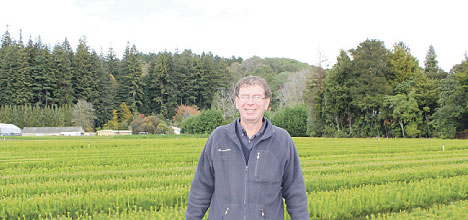
The future of New Zealand's forestry industry is growing in neat rows at the Scion Nursery in Rotorua – but not all the trees are radiata pine.
Cypress, eucalypts, redwoods, Queensland and New Zealand kauri, totara and red beech are propagated too.
Peter Harington, Scion's nursery manager.
Nursery manager Peter Harington says while growing improved varieties of conventional plantation species is the prime focus of the one million plant nursery, it is also researching other species.
'There is a strong interest from iwi groups, in particular, in growing natives for commercial forests. These groups are not concerned that it will take longer, maybe up to 60 years, to harvest as they see forestry as benefiting future generations.”
Some of the work the nursery carries out is for the Radiata Pine Breeding Company - which has been working to breed for improved radiata pine since the late 1980s – and has shareholders that include major forest growing companies in New Zealand and Australia.
Superior
Peter says the nursery grows clonal trees (a tree that can or has cloned itself) selected from those which have shown superior properties, including wood properties and disease resistance, up to the stage where they are ready for planting out.
Grafted trees are also grown for seed orchards, where they will be hand-pollinated and their seed collected for the next generation.
The progress of each new generation of trees is carefully recorded and tracked throughout their life in the nursery, and later in plantations, information which is invaluable in future selections.
Developing new improved tree varieties is not quick. It can take decades to find out if the trees live up to expectations. But research has been going on in New Zealand since the 1940s – so Peter says Scion (originally the Forest Research Institute) has a wealth of knowledge and information from which to draw.
While RPBC is owned by major forestry companies working co-operatively to improve tree stocks. Peter says they focus at a commercial level on growing their forests, selecting plants which will best meet the needs of where they will grow or the end product they produce.
Peter began his career with the New Zealand Forest Service and well remembers collecting pine cones for seed. 'There were no OSH regulations back then. We used to climb up one tree, collect cones then get the tree swaying until it came close enough to the next one so we could grab a branch and jump across. It saved having to climb back down and up again.”
Conservation
The nursery has a conservation focus too, including one project aimed to save the now rare kaka beak.
'There are probably only 109 kaka beak left growing in the wild and we have many more than that growing here,” says Peter.
The project, which is part of wider work to protect the rare plant, was begun by staff member Karen Te Kani. And since Peter joined the nursery last year, more resources have been put into propagation. While kaka beak can be bought from garden centres, what they sell is a hybrid. The work of Scion staff, DOC and private individuals is to preserve the original species, and eventually re-introduce it to the wild.
The nursery is also custodian of the Rene Orchiston collection of 50 flaxes, collected by Rene from iwi throughout the country. 'We are proud to care for this living library of flaxes, which are traditionally used for many different types of weaving and each plant is individually named,” says Peter.
Christmas
Plantation pines must be uniform in shape, with not too many branches down low, but there's one tree in the nursery which breaks all the rules. 'This is our Christmas tree variety,” Peter explains. Its perfect cone shape means it's in demand, for growing trees, for the festive season.
After years in the forestry, working for Carter Holt Harvey, later setting up the 6 million tree Te Ngae Nursery (also at Rotorua), and then being a partner in Woodmetrics for 12 years, Peter is happy managing the Scion nursery.
'I enjoy the people I work with who are dedicated and innovative – and I also get to work with trees which I also love.”

0 comments
Leave a Comment
You must be logged in to make a comment.