


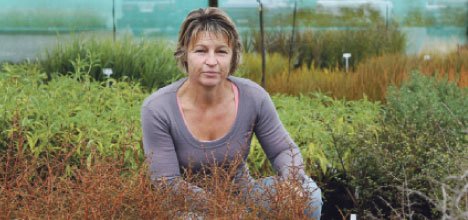
A desire to spend more time with her son, and an opportunity in the market, were the drivers which led Diane Coleman to begin Treeline Native Nursery.
Seventeen years on, her initiative and business skills, especially in the face of tough economic times, have seen Diane win the 2013 RWNZ Enterprising Rural Women Award. Diane also won the Love of the Land category, sponsored by Agrisea Ltd of Paeroa.
Diane Coleman of Treeline Native Nursery is the 2013 RWNZ Enterprising Rural Women of the Year.
However, winning awards was far from her mind when Diane decided growing native plants for Environment Bay of Plenty from a lifestyle block at Kaharoa near Rotorua. She thought it could not only provide an income but mean more time with her five-year-old Sam.
'EBOP was encouraging farmers to re-plant riparian areas and I thought that presented an opportunity. I raised calves to help fund the start-up and John, my husband, built three tunnel houses.”
Diane, who grew up in the Hawkes Bay and has a Horticultural diploma from Lincoln University, had the knowledge, skills and work experience to operate her own nursery. It began by producing 10,000 trees, shrubs and grasses annually.
Eco-sourced
Her perception, that there was a market for eco-sourced, hardy native plants for re-vegetation projects and landscaping, proved correct. And the business grew to the point where today the nursery grows 350,000 plants and employs three full-time and two part-time staff; and up to 10 people during the busiest times.
While similar businesses have struggled or not survived the economic downturn, Treeline Native Nursery has endured – largely due to Diane's ability to change growing techniques, maintaining quality standards but reducing costs, and the significant investment in a truck to deliver plants.
'We could compete on price of plants, but transport costs often added too much to the contract price so John suggested we buy our own vehicle,” says Diane.
Truck
The attractively sign-written truck has now become familiar throughout the Bay of Plenty and Waikato, delivering plants free for bulk orders.
'The truck really proved its worth when we won a contract to supply plants to farmers in the Hauraki District. We had been asked to set up a depot but said we would rather deliver direct to farmers who have appreciated us turning up with the truck, and the quality of our plants. They also like the opportunity to talk to us about the plants and how to care for them,” says Diane.
Seed collecting is an important part of the nursery's operation and Diane travels the Bay of Plenty and Waikato gathering seeds so that plants are grown from seeds true to each area – a practice called eco-sourcing.
Some native plant seeds can be hard to propagate, including kowhai, but nursery staff have perfected ways of germinating them successfully, using Daltons' mixes.
Hardy
The nursery, which now covers about three ha, is at 419m above sea level and the winters can be harsh. 'This ensures the plants are hardy and relatively pest-free.” While Diane describes herself as a traditional nursery woman who likes to use conventional nursery practices, including pricking out plants by hand, she is open to alternative ideas.
One which has proved particularly useful is an old Allied Farmers Co-op lunar calendar which recommends the optimum times for planting seeds, re-potting or taking cutting from plants.
Moon
'We've used it for three years now with surprisingly good results, producing more cuttings than ever before. I'm not totally sure it is all to do with the moon but by being disciplined to carry out taking cuttings and propagation during certain days every month we have streamlined our operations,” says Gina.
Colour is a striking aspect of Treeline Nursery. The hundreds of native trees, shrubs, flaxes and grasses, grouped by species, create a wash of hues from blue-grey to silver, chocolate brown to bronze to copper, to all shades of green.
There's nothing dull about New Zealand natives, something landscapers, gardeners, councils and farmers are discovering.
Growing plants - which will re-clothe the land in its original vegetation, protect waterways, reduce erosion and provide food for native birds and bees - is a source of pride for Diane and her staff.

0 comments
Leave a Comment
You must be logged in to make a comment.